Learn
Warrior Trading Review: Ross Cameron's Results, Costs and FTC Case
At a glance
Ross Cameron publishes an accountant's report about specified trading accounts. It does not establish a typical student's return. This review examines the report's scope, current advertised costs and the 2022 FTC order before considering what a buyer can reasonably conclude.
On this page

Is Warrior Trading worth paying for? Ross Cameron's published account documentation helps answer whether specified personal trading results have outside support. It cannot tell you your probability of making money after buying his courses. Our assessment: evaluate the education against a defined learning need and a complete budget; do not treat the instructor's gains as your expected return.
Scope and disclosure: This is a review of public documents, not a hands-on course or live-room test. Sources and advertised prices checked September 27, 2026. RoboXpert develops and offers trading software and has a commercial interest in this market. There are no affiliate links in this article. Our own products deserve the same scrutiny.
What is the Warrior Trading business model?
Warrior Trading sells trading education associated with Ross Cameron, alongside optional tools and community access. Its membership comparison separates course memberships from recurring software, simulator and stream/chat subscriptions.
That distinction matters economically: a customer pays for access and instruction. The fee is not a share of that customer's eventual trading profit. Selling education does not itself establish wrongdoing, and being a profitable instructor does not itself establish that the course works for a typical buyer.
There are three separate questions: what can the instructor demonstrate, what does the teaching deliver, and what happens to students after costs? A document answering one should not be used as a substitute for the other two.
What does Ross Cameron's accountant report actually cover?
We read the seven report pages published on the verified-earnings page, including the methodology notes.
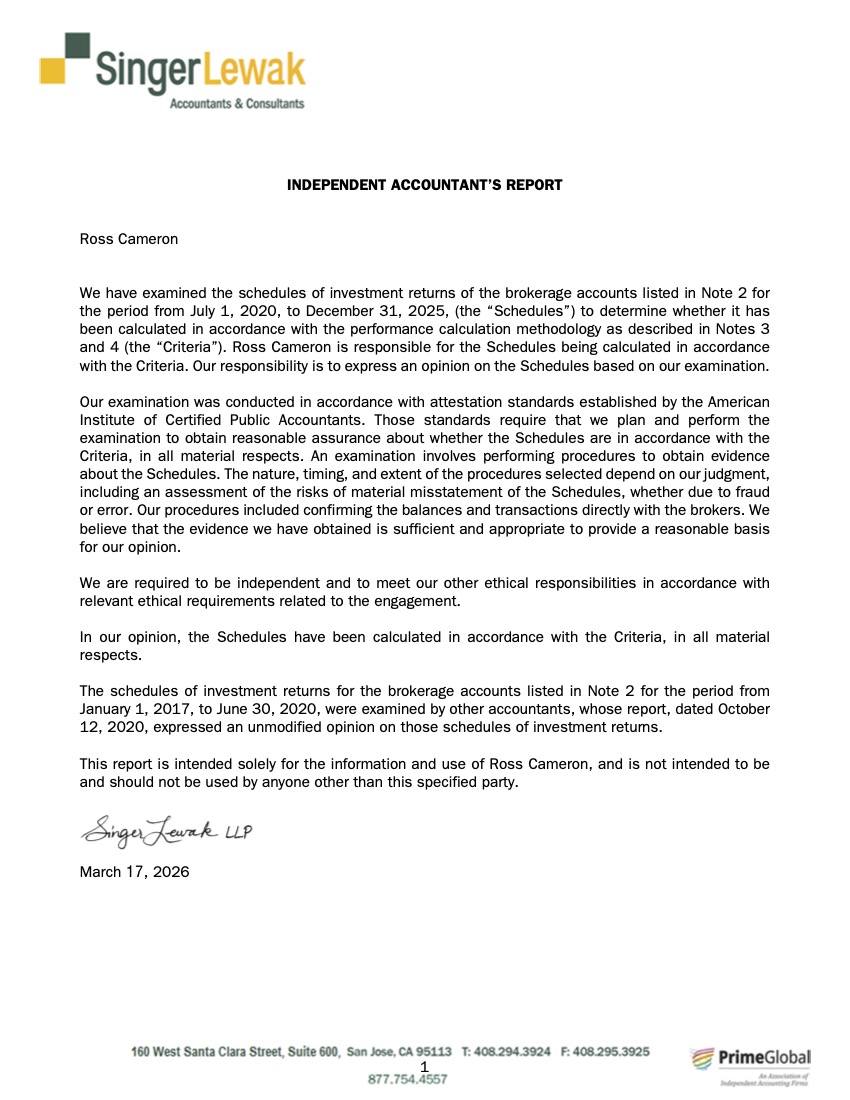
- Page 1: SingerLewak's March 17, 2026 examination covers July 2020–December 2025. It describes broker confirmations and an opinion on calculations against specified criteria. Earlier periods were examined by other accountants. It also restricts intended use to Cameron.
- Page 6: The presentation covers the accounts and periods listed in Note 2.
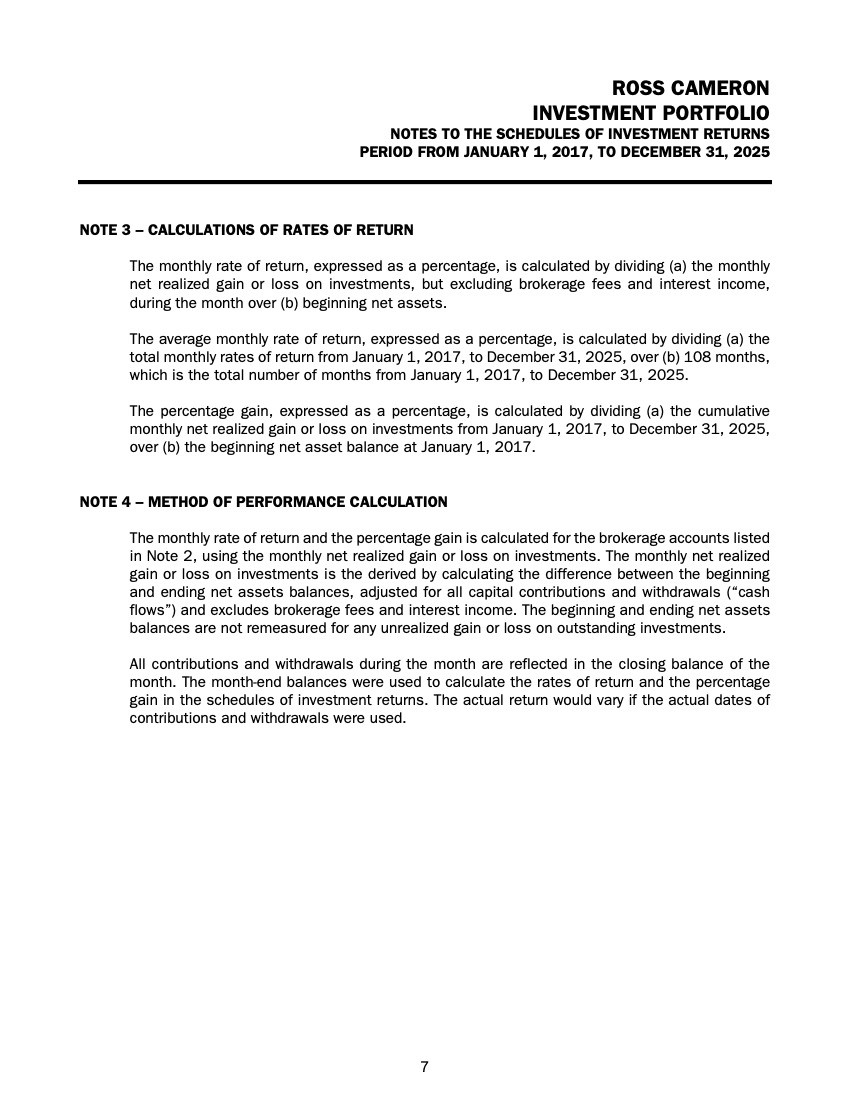
- Page 7: Calculations exclude brokerage fees and interest income. Outstanding investments are not remeasured for unrealized gains or losses. Cash-flow timing uses month-end treatment.
- Page 5: The schedules show $18,810,638 total profits over 2017–2025 and $96,630 ending equity. Withdrawals net of contributions are separately reported.
These are descriptions of the published report, not a RoboXpert audit. The examination is meaningful outside evidence with a defined scope; it is not a certification of course quality or student outcomes. Read the accountant's opinion on page 1 and calculation notes on page 7.
Why an average monthly return is not a compounding forecast
The report's 61% average monthly return is an arithmetic average under its stated methodology. It is not a promise of earning that rate each month.
Our hypothetical illustration: an account rising 100% and then falling 50% has an arithmetic average monthly return of 25%. Yet $1,000 becomes $2,000 and then returns to $1,000. Its two-month compounded return is zero. This is not Cameron's trading sequence; it explains why an average alone cannot reconstruct an account's path.
Similarly, cumulative profits and the money still in an account measure different things when withdrawals occur. Read cash flows alongside returns rather than assuming a headline profit is today's account balance. Our trading-results verification guide explains the broader account checks.
Do Warrior Trading students make money?
The provider's current performance disclosure describes Cameron's and featured traders' outcomes as atypical and says it does not track typical customer results. Its annual-report section also distinguishes the completed 2025 period from a 2026 report expected in 2027.
That leaves a practical evidence gap: we cannot calculate a current student success rate from these materials. Selected testimonials cannot supply the missing denominator. Neither can a regulator's historical allegation be converted into a measured success rate for today's students.
Here is our framework for keeping the questions separate:
Scroll horizontally if needed
| Evidence | What it can help establish | What it does not establish |
|---|---|---|
| Instructor account examination | Results within the report's scope and calculation rules | Your likely return or the effect of taking a course |
| Curriculum and sample lessons | Topics covered and whether the teaching format suits you | That completing lessons produces profitable execution |
| Selected student stories | An individual experience, if adequately documented | The proportion of all students who succeed |
| A defined student cohort | Outcomes for the included participants and period | Causation without accounting for selection and other influences |
For a useful cohort analysis, ask how dropouts, inactive accounts, losing participants and course costs are counted. Missing data is a reason to leave a claim unverified, not to invent a positive or negative percentage.
What happened in the Warrior Trading FTC case?
The FTC's April 2022 announcement described allegations of misleading earnings claims and losses in the vast majority of customer accounts it discussed. Those are the agency's historical allegations, not results from a current customer survey by RoboXpert.
The stipulated order filed May 25, 2022 imposed a $3 million monetary judgment. Section I requires earnings claims to be non-misleading and supported by written substantiation available on request. Section II addresses representations about aptitude, experience, capital and time, among other matters. The findings state that the defendants neither admit nor deny the allegations, subject to the order's exceptions.
This was a civil settlement order. It is not a criminal conviction, a blanket ban on selling courses, or proof of a new violation in 2026. The FTC refund page records distributions in 2023 and 2024; that history should not be presented as a newly opened refund programme.
How much does Warrior Trading cost?
The public membership page displayed the following US-dollar prices on September 27, 2026. Promotions and checkout terms can change.
Scroll horizontally if needed
| Offer | Displayed price | Relevant access limit |
|---|---|---|
| Warrior Starter | $797 promotional / $997 reference price | Three years of course access |
| Warrior Pro | $2,997 promotional / $3,997 reference price | Three years of course access |
| Warrior Pro Special | $3,997 promotional | Includes one year of stream/chat and 90 days of software and simulator access |
| Day Trade Dash with simulator | $197/month for members | Recurring add-on |
| Live stream and chat | $147/month for members | Recurring add-on |
Our illustrative budget: buying the displayed $2,997 Pro membership and separately maintaining the $197 and $147 monthly add-ons for 12 months totals $7,125: $2,997 + 12 × ($197 + $147). This is a selected combination, not the cheapest package or a checkout quote. It excludes taxes, brokerage costs and trading losses. Avoid counting a bundle's included access twice.
The practical question is whether the learning benefit warrants the money and time even if trading generates no income. Check the exact package, renewal date and written refund terms before purchase.
A buyer's evidence check before paying
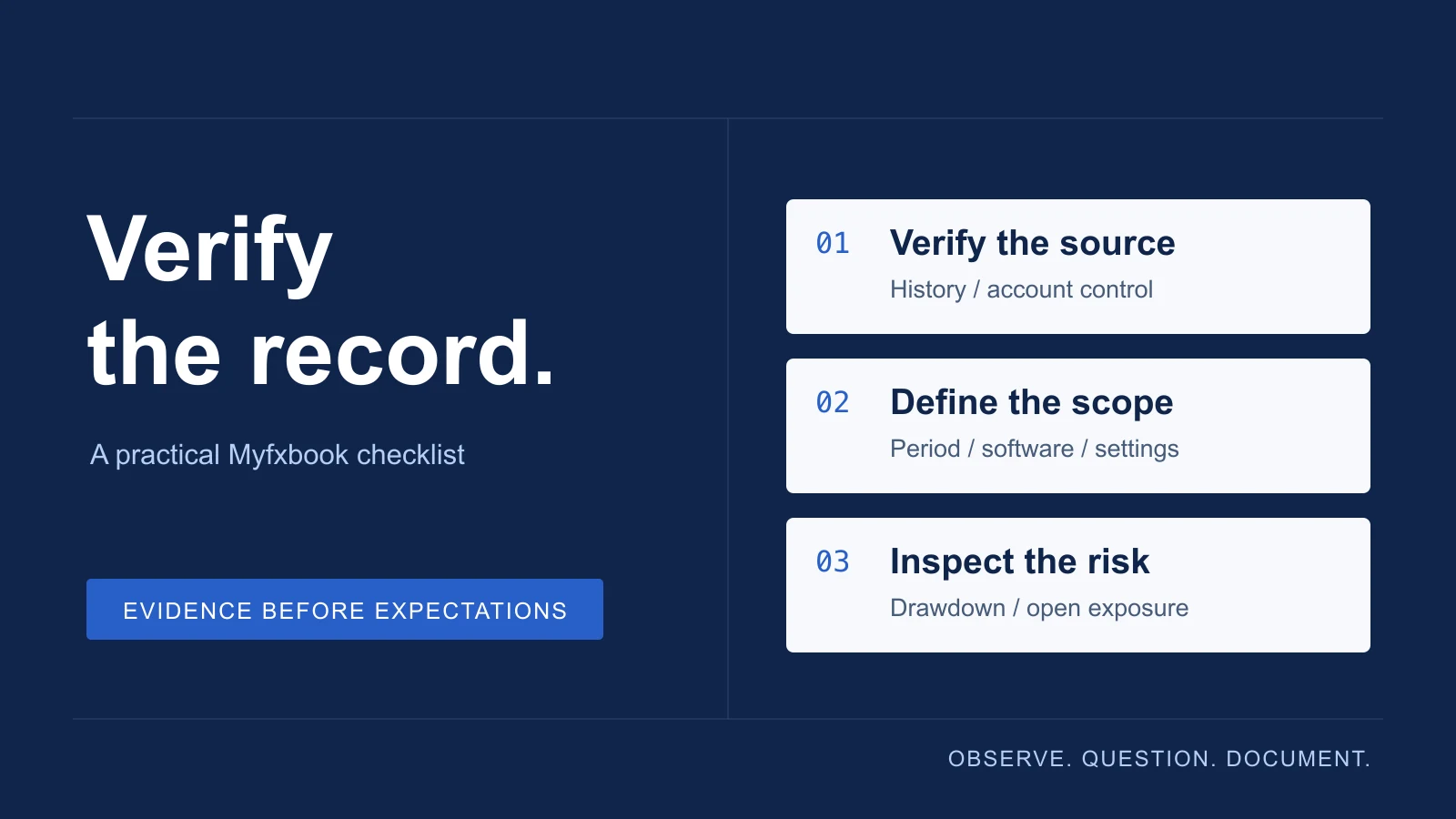
- Define the lesson you need. Write a specific objective, such as understanding order entry or recording a repeatable setup. “Replace my salary” is an outcome hope, not a curriculum requirement.
- Examine sample material. Assess clarity and whether the instructor explains losing examples, execution assumptions and limitations. We have not rated the paid curriculum here.
- Match each claim to a document. Record whose account, which dates, included costs and the report's actual conclusion.
- Request student evidence if student earnings influence the purchase. A refusal or unavailable dataset leaves that expectation unsupported.
- Set a complete budget. Separate tuition, recurring tools and the capital exposed to market losses. Do not assume future gains will fund subscriptions.
- Keep your decision record. Save the offer and terms you actually saw; use the downloadable worksheet to compare alternatives consistently.
Our assessment
The published accountant's report is a substantive transparency point. The lack of tracked typical customer outcomes remains a different, unresolved question. The 2022 order is relevant purchasing context, while current claims and terms still deserve their own examination.
For a reader seeking a reliable income shortcut, these documents do not establish one. For someone considering structured education, the next useful step is to evaluate the teaching and total cost against a specific learning goal. Use our results checklist whenever performance is part of a sales pitch, including ours.

Sources & further reading
Your next question