Learn
Is Bitcoin More Volatile on Weekends? Six Years of Data, 2020–2026
At a glance
No. Bitcoin weekend volatility is lower than on weekdays, and the gap has grown. On Binance from July 2022 to 18 October 2026, the median Saturday moved 1.59% from its high to its low and the median Sunday 2.39%, against 3.37% to 3.73% from Monday to Friday. Moves of 5% or more from one close to the next happened on 1.3% of Saturdays and 2.2% of Sundays, against 6.7% to 8.0% of weekdays. There is no weekend dump in the data: 52% of weekend days closed higher. Calm is not the same as safe. The worst weekend day lost 6.55% (31 January 2026), and the quiet stretch ends on Sunday evening, around 21:00 to 22:00 UTC, when futures and forex reopen.
On this page

Bitcoin trades every day of the week, but most of the people and firms who move it do not. Banks, ETFs and futures exchanges close on Friday evening. What is left on Saturday and Sunday is a thinner market, and many traders ask whether that makes the weekend wilder or quieter.
We measured it on six years of minute prices. The short answer: quieter, and much quieter than it used to be. The long answer has a few traps in it, and they matter if you let a trading bot run over the weekend.
Disclosure: RoboXpert develops trading software, including an Expert Advisor that trades Bitcoin only on weekends, and has a commercial interest in this subject. All numbers come from Binance spot prices for BTCUSDT in one-minute bars from 1 July 2020 to 18 October 2026, analysed on 31 October 2026 with the script you can download below. They describe the past. They are not a forecast and not a recommendation to buy or sell Bitcoin. AI assisted with the analysis and the drafting. See our editorial methodology.
Bitcoin weekend volatility by day of the week
We cut the data into UTC calendar days and measured two things for each day:
- Range: how far the price moved from the day’s low to its high, in percent of the opening price.
- Return: the close of the day against the close of the day before.
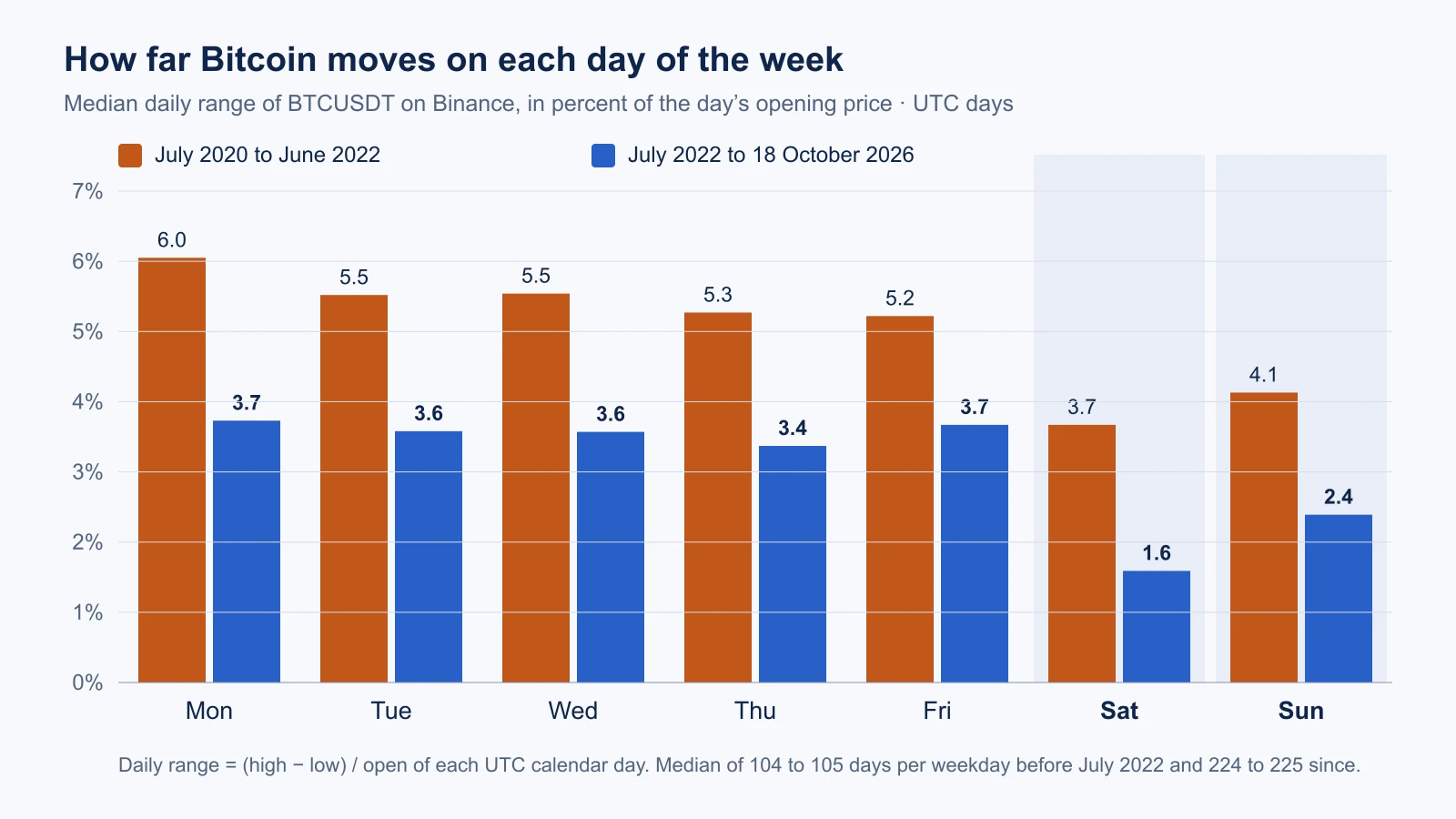
The same numbers as a table, for the period since July 2022:
Scroll horizontally if needed
| Day (UTC) | Days | Median range | Closed higher | Moves of 5% or more | Worst day |
|---|---|---|---|---|---|
| Monday | 224 | 3.73% | 53.1% | 18 | −8.54%, 3 March 2025 |
| Tuesday | 224 | 3.58% | 46.0% | 16 | −9.93%, 8 November 2022 |
| Wednesday | 224 | 3.57% | 49.6% | 15 | −14.15%, 9 November 2022 |
| Thursday | 224 | 3.37% | 46.0% | 15 | −14.02%, 5 February 2026 |
| Friday | 225 | 3.67% | 50.2% | 15 | −10.16%, 19 August 2022 |
| Saturday | 225 | 1.59% | 51.6% | 3 | −6.55%, 31 January 2026 |
| Sunday | 225 | 2.39% | 52.0% | 5 | −6.37%, 9 March 2025 |
A median Saturday moves less than half as far as a median weekday. Sunday sits in between, for a reason the hourly data shows below.
The two-day view says the same. From Friday’s close to Sunday’s close, the median move since July 2022 was 1.13% in either direction. From Monday’s close to Wednesday’s close it was 2.28%. The worst weekend lost 8.65%; the worst Tuesday and Wednesday together lost 22.67%.
Does Bitcoin go down on weekends?
Not in this data. Since July 2022, 51.6% of Saturdays and 52.0% of Sundays closed higher than the day before. The average Saturday gained 0.02% and the average Sunday 0.13%, which is close to nothing.
The idea of a weekend dump comes mostly from 2021, when several large crashes fell on weekends. In our earlier period, from July 2020 to June 2022, weekends were also not weaker: 58.7% of Saturdays and 51.9% of Sundays closed higher.
What is true: the largest single-day crashes since mid-2022 all fell on weekdays. The five worst weekdays lost between 9.92% and 14.15%. The five worst weekend days lost between 4.76% and 6.55%.
Which hours of the weekend move most?
For each of the 168 hours of the week we took the median range of that clock hour over all weeks since July 2022.
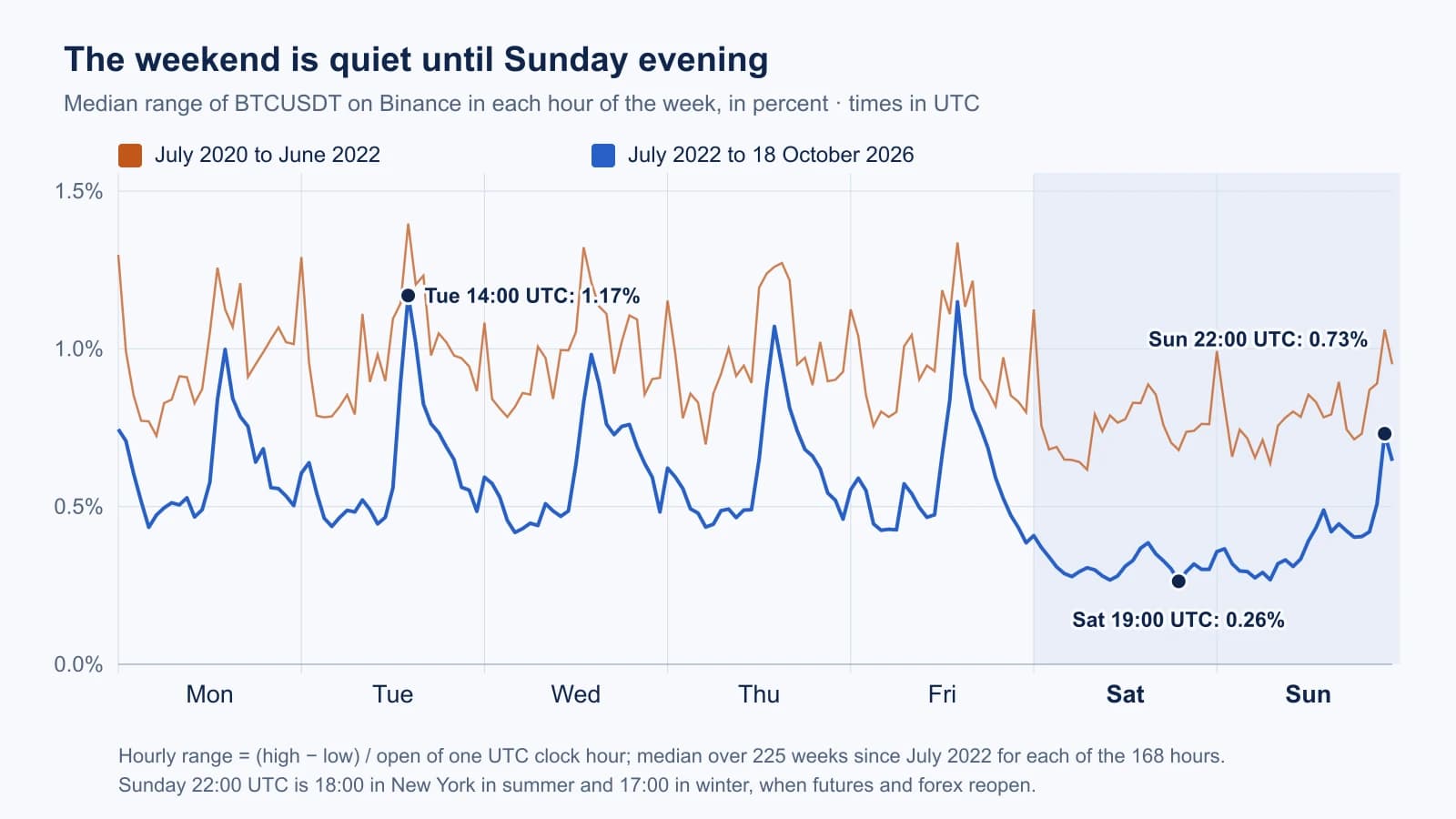
Three things stand out:
- Weekdays have a heartbeat. On every weekday the busiest hour is 14:00 UTC, in the US morning around the opening of the stock market. The busiest of them is Tuesday, with a median range of 1.17%.
- The weekend is flat. From Saturday 04:00 to Sunday 16:00 UTC, the typical hour moves 0.26% to 0.49%. The quietest hour of the week is Saturday at 19:00 UTC, at 0.26%.
- Sunday evening wakes up. From about 21:00 UTC the range rises, to 0.73% at 22:00 UTC. That is when futures and forex markets reopen for the new week: 22:00 UTC is 18:00 in New York in summer, and 23:00 UTC is 18:00 in winter. In Germany it is around midnight.
Friday night already belongs to the quiet part. From the US close at about 20:00 UTC, the range falls into Saturday, apart from a small rise at midnight UTC.
Large hourly moves are rare on weekends but not absent. Since July 2022 we counted 50 weekend hours with a range of 2.5% or more, across 450 weekend days. On 1,121 weekdays there were 486. Per day that is about 0.11 such hours on a weekend day and 0.43 on a weekday.
When did Bitcoin on weekends get calmer?
For each half-year we divided the median range of weekend days by the median range of weekdays. A value of 1.00 would mean both move the same.
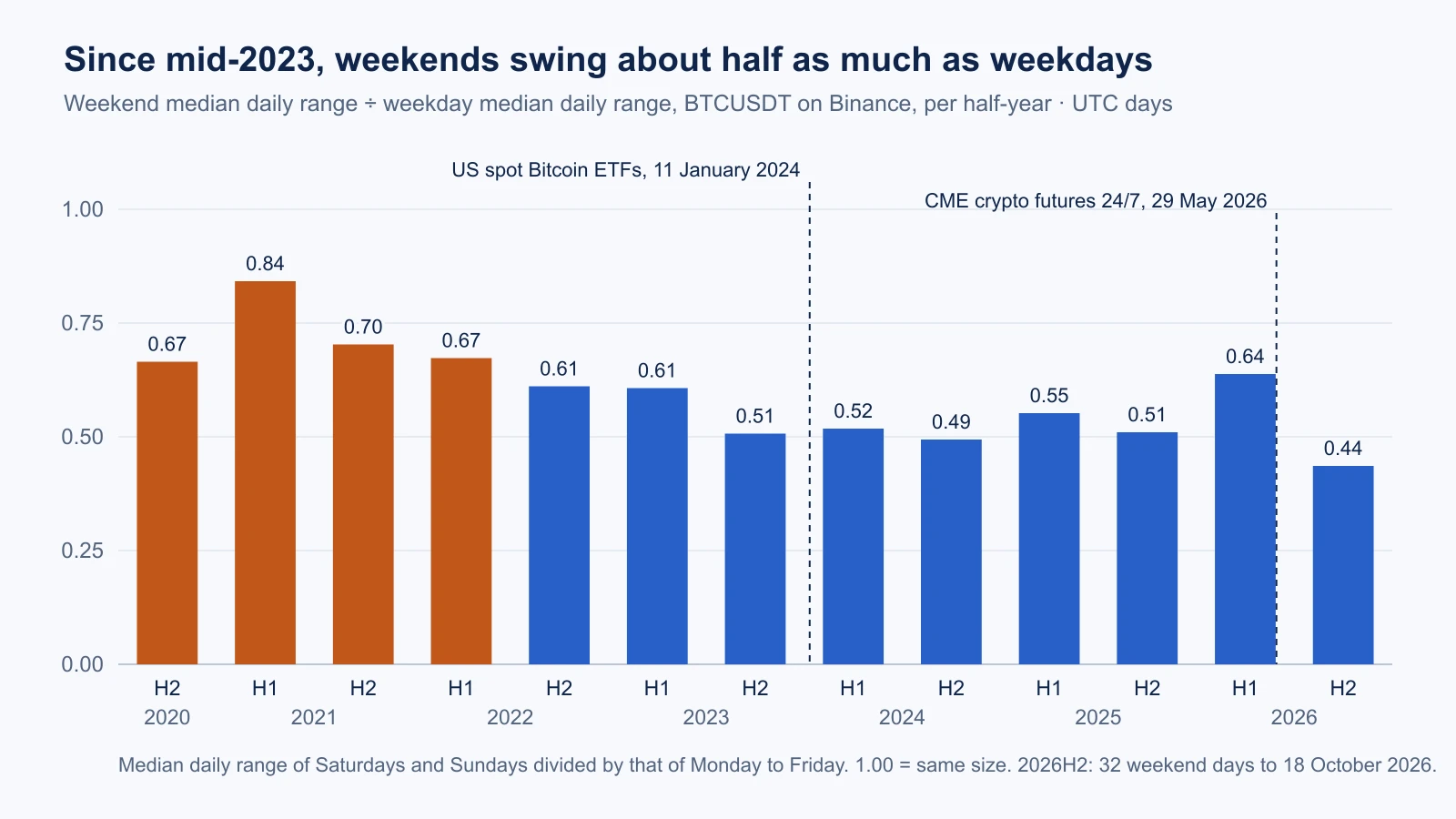
The ratio and the weekend share of Binance's volume, grouped by period:
Scroll horizontally if needed
| Period | Weekend range ÷ weekday range | Weekend share of Binance volume |
|---|---|---|
| 2020 H2 to 2021 H2 | 0.67 to 0.84 | 22.4% to 24.3% |
| 2022 H1 | 0.67 | 18.9% |
| 2022 H2 to 2023 H1 | 0.61 | 19.6% to 20.7% |
| 2023 H2 to 2026 H2 | 0.44 to 0.64 | 15.4% to 18.7% |
Two days of seven are 28.6% of the week. Weekends have carried less than that share of Binance’s BTCUSDT volume throughout, and less again since 2023.
The change came in steps, not on one date. The weekend calmed relative to weekdays from mid-2022 and reached about half of the weekday range from the second half of 2023. The launch of US spot Bitcoin ETFs in January 2024 (SEC statement) did not start the shift; it was already there. We split the data at 1 July 2022 because that is where the series turns.
What happened to the CME gap?
For years, CME Bitcoin futures stopped trading on Friday afternoon and reopened on Sunday evening, Chicago time. The difference between the two prices was called the CME gap, and a popular belief says these gaps always fill.
Two things have changed that story.
CME no longer closes for the weekend. CME Group launched round-the-clock trading of its crypto futures and options on Friday 29 May 2026, according to its release of 1 June 2026. More than 7,200 contracts, about 50 million USD in notional value, traded on the first weekend. A futures market that does not close leaves no weekend gap of its own.
The fill rate was never close to 100% in our proxy. We do not have CME’s futures prices. As a stand-in, we compared Binance spot at the old CME Friday close (16:00 Chicago) with spot at the old Sunday reopen (17:00 Chicago), and checked when the price touched the Friday level again:
Scroll horizontally if needed
| Weekends from July 2020 to 22 May 2026 | Count |
|---|---|
| Weekends measured | 308 |
| Median gap, either direction | 1.01% |
| Gaps of 1% or more | 156 |
| Back at the Friday price within 1 day | 62 (40%) |
| Within 7 days | 108 (69%) |
| Within 30 days | 130 (83%) |
In the 21 weekends since 29 May 2026, the median move between the two old times was 0.46%, and only five were 1% or more. A spot proxy is not the futures gap: the futures traded at a premium or discount to spot. So read the table as what a weekend move on spot did afterwards, not as the official gap statistic.
What this means for a trading bot on MT5
Most retail traders who automate Bitcoin on a weekend do it through a broker’s BTCUSD contract in MetaTrader 5, not on Binance. The prices follow the exchange closely. In our own tick comparisons for our Bitcoin EA, one broker’s mid price matched the Binance close of the same second with a median difference of 0 USD; another broker’s price ran at a wandering offset of up to about 160 USD that changed slowly. The swings are the same; the level can differ.
Four points follow from the data:
- A calm market suits strategies that live on small swings and suffers on big runs. A grid or a mean-reversion EA earns on the back and forth of a quiet Saturday and loses when the price runs one way. Weekend data favours the first case far more often than weekday data, but not always.
- Plan for the bad weekend, not the median one. A weekend day of −6.55% and a two-day move of −8.65% happened in this period. Size positions for that, and use a hard stop.
- Sunday evening is the riskiest part of the weekend. If a bot only has to run on a calm market, ending before about 21:00 UTC on Sunday avoids the reopening hours.
- Check the clock of your broker. MetaTrader 5 shows server time, not UTC. Many brokers run their server at UTC+2 or UTC+3, so their “Saturday 00:00” is 21:00 or 22:00 UTC on Friday. A rule written for “Saturday” starts at a different moment at a broker whose server runs on UTC.
What this data does not show
- One exchange. Binance spot BTCUSDT only. Other exchanges and broker CFDs move with it, but their spreads, gaps at the broker’s daily rollover and swap charges are not in these numbers.
- No costs. Range and return are price measures. A bot pays spread and swap, and both differ by broker and by hour.
- Volume is Binance’s volume, not the whole market.
- The past. Six years contain one full bull run, the 2022 crash and the 2024 to 2026 market. A new regime can change the pattern, as the 2021 numbers show.
- No causes. We show when the weekend became calmer, not why. Fewer traders active on weekends is a plausible reason; we did not test it.
- Our own split. We chose 1 July 2022 from the half-year series. Another split date moves the numbers a little, not the picture.
The script that computes every number above, its output and the script for the figures are in the download. You can rerun it on newer data from the Binance portal.
Download the analysis (ZIP). The Python script that computes every number in this guide from Binance minute data, its output file, and the script that draws the figures. No price data.
Frequently asked questions
Is Bitcoin more volatile on weekends?
No. Since July 2022 the median Saturday moved 1.59% from low to high and the median Sunday 2.39%, against 3.37% to 3.73% on weekdays. Before mid-2022 weekends were also calmer, but by less: the weekend range was 67% to 84% of the weekday range, against about half since 2023.
Why is Bitcoin so quiet on Saturdays?
Banks, ETFs and most futures markets are closed, and fewer professional traders are active. Weekends carried 15% to 19% of Binance’s BTCUSDT volume in each half-year since mid-2023, although they are 29% of the days. We measured the calm, not its cause.
Does crypto dump on Sundays?
Not on average. 52.0% of Sundays since July 2022 closed higher than Saturday. Sunday moves more than Saturday because the evening hours from about 21:00 UTC, when futures and forex reopen, are busy.
What time is Bitcoin most volatile?
On weekdays at 14:00 UTC, in the US morning; the busiest hour of the week was Tuesday at 14:00 UTC. On weekends, Sunday at 22:00 UTC. The quietest hour was Saturday at 19:00 UTC.
Do CME gaps always fill?
Not in our spot proxy. Of 156 weekend moves of 1% or more between July 2020 and May 2026, the price was back at the Friday level within a day in 40% of cases, within a week in 69% and within 30 days in 83%. Since 29 May 2026 CME trades crypto futures around the clock, so the classic weekend gap no longer forms there.
Is it safe to run a trading bot on Bitcoin over the weekend?
Safer than on a typical weekday in this data, not safe. Weekend days lost up to 6.55% in a day and 8.65% over two days. A bot needs a stop, a position size that survives such a weekend, and a broker whose server time you have checked.

Sources & further reading
- Binance public data: spot klines BTCUSDT 1m
- Binance public data: file format and timestamps
- CME Group Announces Launch of 24/7 Cryptocurrency Futures and Options Trading (release of 1 June 2026, as published by Mondo Visione)
- SEC: Statement on the approval of spot bitcoin exchange-traded products, 10 January 2024
Your next question