Learn
FTMO Review: What Are You Really Paying For?
At a glance
An FTMO CFD Challenge buys access to a simulated evaluation, not ownership of the advertised account balance. Real rewards are conditional, and the fee-refund rules differ between 1-Step and 2-Step. Calculate repeated-attempt costs and check whether your EA fits the rules.
On this page

Is FTMO worth the fee? It can be worth evaluating if you already have evidence that your strategy fits its rules and can afford the entire attempt budget. Buying a Challenge does not give you the advertised balance to withdraw. Our assessment: compare the loss limits, refund conditions and your cash costs before comparing account sizes.
Scope and disclosure: Public-document and pricing review, checked September 27, 2026; no purchased Challenge, execution test or payout test. We cover the Global CFD offering on ftmo.com, not FTMO Futures or regional storefronts. RoboXpert develops and offers trading software and has a commercial interest in this market. This article contains no affiliate links; our software needs the same checks.
What is FTMO's business model?
You pay for a trading evaluation and associated services. FTMO says its fee covers the simulated environment, infrastructure and tools. Qualifying traders can subsequently earn contractual, performance-based cash rewards.
For this CFD offering, the Free Trial, evaluation and FTMO Account all use simulated capital. FTMO separately says it may use account data to trade its own live accounts. That does not turn your displayed balance into your bankable money. See its explanation of simulated trading.
How does FTMO make money? Challenge fees are a visible revenue source; its own separate trading is another activity it describes. These public product pages do not establish the group's revenue mix or where each reward payment is funded. We therefore do not claim that all revenue comes from failed traders, or that simulated trading by itself establishes wrongdoing.
The useful distinction is between what you buy, what you can lose in fees, and what must happen before you receive cash. A large nominal balance answers none of those questions on its own.
FTMO 1-Step vs 2-Step: the differences that matter
The shorter evaluation has a different rule set. This is a selective comparison, not the full contract. FTMO's comparison table is the primary reference.
Scroll horizontally if needed
| Feature | 1-Step | 2-Step |
|---|---|---|
| Evaluation target | 10% | 10%, then 5% in Verification |
| Daily loss amount | 3% of initial simulated capital | 5% of initial simulated capital |
| Maximum loss | 10%; end-of-day trailing floor | 10%; static floor |
| Minimum trading days | No separate minimum-day objective | Four per evaluation phase |
| Best Day rule | 50% | Not part of this product's objectives |
| Account types | Standard | Standard or Swing |
| Starting reward share | 90% | 80%; can increase to 90% under additional conditions |
| Entry-fee refund | No | Qualifying fee with first eligible reward withdrawal |
The reward FAQ supplies the starting shares; “up to 90%” should not be read as the default 2-Step share. The refund FAQ distinguishes the products explicitly. Passing alone is not the same as receiving a refund.
Current advertised fees
We checked the Global homepage's pricing selector with USD simulated account sizes and EUR fees. These are different units. The two discounted prices below were displayed on September 27, 2026; availability and final checkout terms can change. Official pricing.
Scroll horizontally if needed
| Simulated account size | 1-Step fee shown | 2-Step fee shown |
|---|---|---|
| $10,000 | €79 | €89 |
| $25,000 | €199 | €250 |
| $50,000 | €319 | €345 |
| $100,000 | €399 promotional; €499 also displayed | €439 promotional; €540 also displayed |
| $200,000 | €999 | €1,080 |
Use the amount you would actually pay in the calculator. A lower advertised fee is not evidence of a better chance of receiving a reward.
Calculate your FTMO Challenge cost
Count the cash, not the account size
Model a fixed number of paid attempts. These are hypothetical outcomes, not a prediction of passing or receiving a reward.
Enable JavaScript to edit the scenario. The worked example below shows the same calculation: three €89 attempts plus €60 expenses cost €327 before any reward or refund.
All cash amounts are in EUR. Convert a reward into EUR yourself, after the profit split and conversion charges, excluding any fee refund. The fee stays editable when you switch plans.
- Total cash spent
- €327.00
- Fee refund in this scenario
- €0.00
- Reward needed to cover costs
- €327.00
- Net cash after this outcome
- -€327.00
No reward means no reward-related fee refund in this scenario, even if you passed the evaluation.
Assumes the same fee on every attempt and at most one successful account. Include software, VPS and payment costs in other expenses. Taxes and time are excluded. Nothing is saved or sent.
Worked hypothetical example: three paid 2-Step attempts at €89 each, plus €60 total software or hosting expenses, cost €327. If no reward arrives, the cash result is −€327. If the third attempt leads to a €200 reward and the qualifying €89 fee is refunded, the cash result is €200 + €89 − €327 = −€38, before tax.
The two earlier fees still count. In that second scenario, the reward required to cover costs is €238 after the profit split, converted to the fee currency. It is not a forecast of how much simulated trading profit you will produce.
Our formula is cash result = reward received + qualifying refund − all paid attempts − other expenses. The calculator assumes identical fees across attempts and one qualifying account. For mixed prices, promotions or multiple successful accounts, use an itemized cash ledger instead. No pass rate is assumed, and choosing three attempts is an illustration, not a spending recommendation.
A $100,000 account is not a $100,000 loss budget
Our hypothetical illustration: at the start of a $100,000 2-Step account, the overall floor is $90,000 and the daily floor is $95,000. Neither figure describes cash that belongs to you. Your personal expenditure is the fee and associated costs; the account limits govern simulated trading.
Daily limits use equity, including floating P/L and trading costs, and reset from balance at 00:00 CE(S)T. For 1-Step, the overall floor trails the highest qualifying midnight balance: at a $104,000 high, the floor is $94,000. It does not fall when balance later drops. A reward withdrawal with a new account resets that floor. Calculation rules.
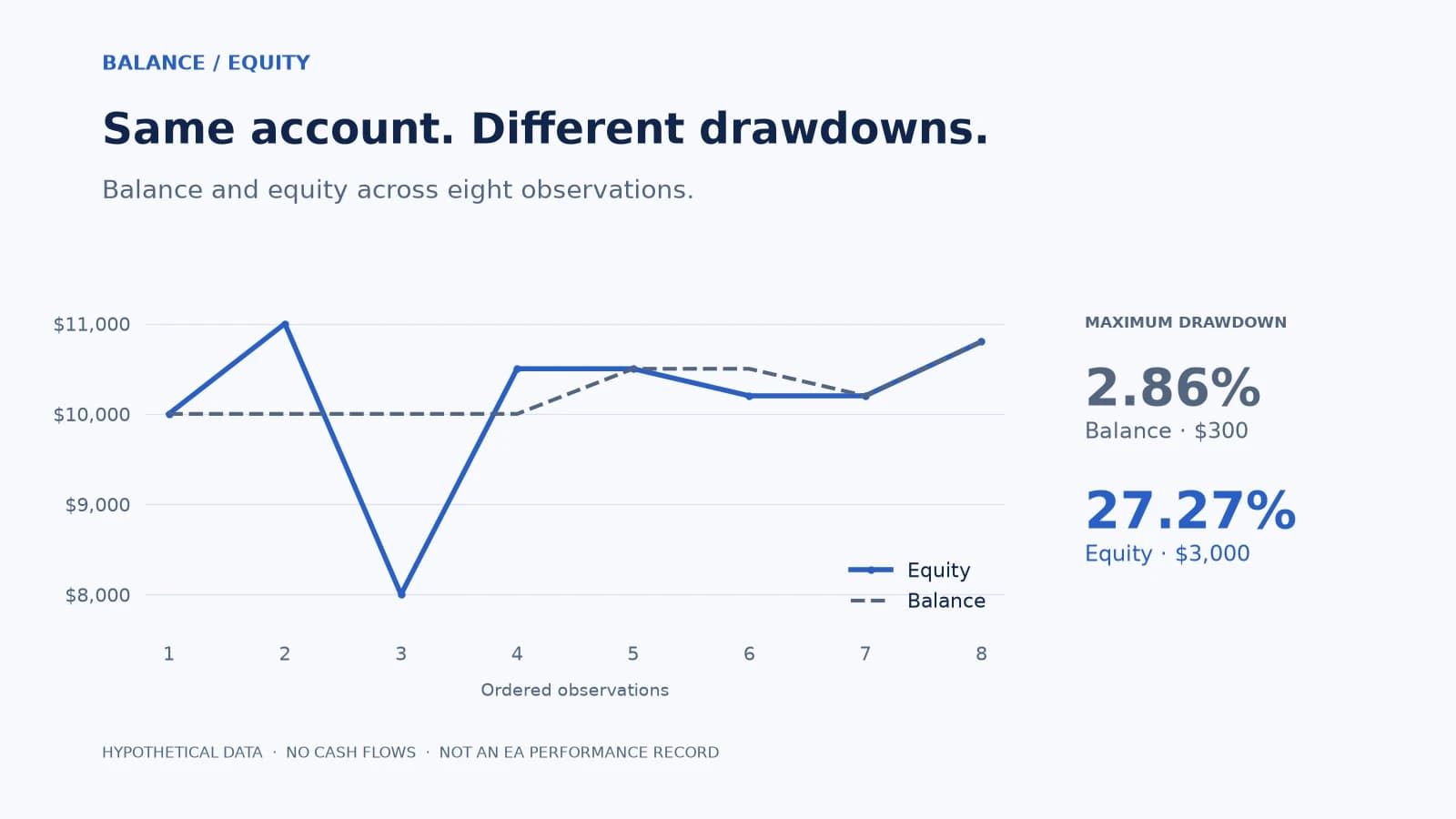
This is why an EA's closed-trade profit curve is insufficient. Test its intraday equity and positions carried across midnight. Our equity-versus-balance guide illustrates the missing information.
For 1-Step, the Best Day must contribute no more than half of the sum of profitable days' closed results. Losing days do not form that denominator. Exceeding this ratio requires more qualifying profit; FTMO says it is not itself a breach. Best Day definition.
Can you use an EA or AI trading bot on FTMO?
EAs are permitted in principle, not approved indiscriminately. FTMO's strategy FAQ requires legitimate trading, appropriate risk management and compliance with its rules. It also warns that a widely shared third-party EA can create maximum-capital-allocation problems when other traders run the same strategy.
The forbidden-practices policy includes abusive or manipulative software use and EA hyperactivity exceeding 2,000 server requests per day. Requests include order modifications, not just completed trades. An “AI” label neither grants an exception nor proves an EA is unsuitable.
Use this pre-purchase checklist with your developer:
Scroll horizontally if needed
| Check | Evidence to keep |
|---|---|
| Exact product and phase | Dated rules for 1-Step or 2-Step, Standard or Swing, and your region |
| Daily equity control | Logs around midnight CE(S)T, floating losses, commissions and swaps; verified time-zone handling |
| Overall loss floor | Test path for the applicable static or trailing rule, including a gain followed by a loss |
| Profit concentration | For 1-Step, daily closed results and the Best Day calculation |
| News and holding behavior | Entry, exit, stop-loss and take-profit behavior around restricted events and market closures |
| Order activity | Counts of new, modified and cancelled orders; throttling and reconnect behavior |
| Shared strategy and permissions | Relevant provider clarification for the exact EA; no assumption that another buyer's approval transfers |
| Financial stop rule | A fixed total budget, including tools and VPS, and a decision point before another purchase |
A phase change matters: FTMO's selected-news restriction applies to Standard FTMO Accounts after evaluation, with an exception for Swing. It includes triggered stop-loss and take-profit orders on affected instruments within the restricted window. Passing the Challenge does not demonstrate that the same unattended configuration fits the later account. Check the news rules and overnight/weekend rules separately.
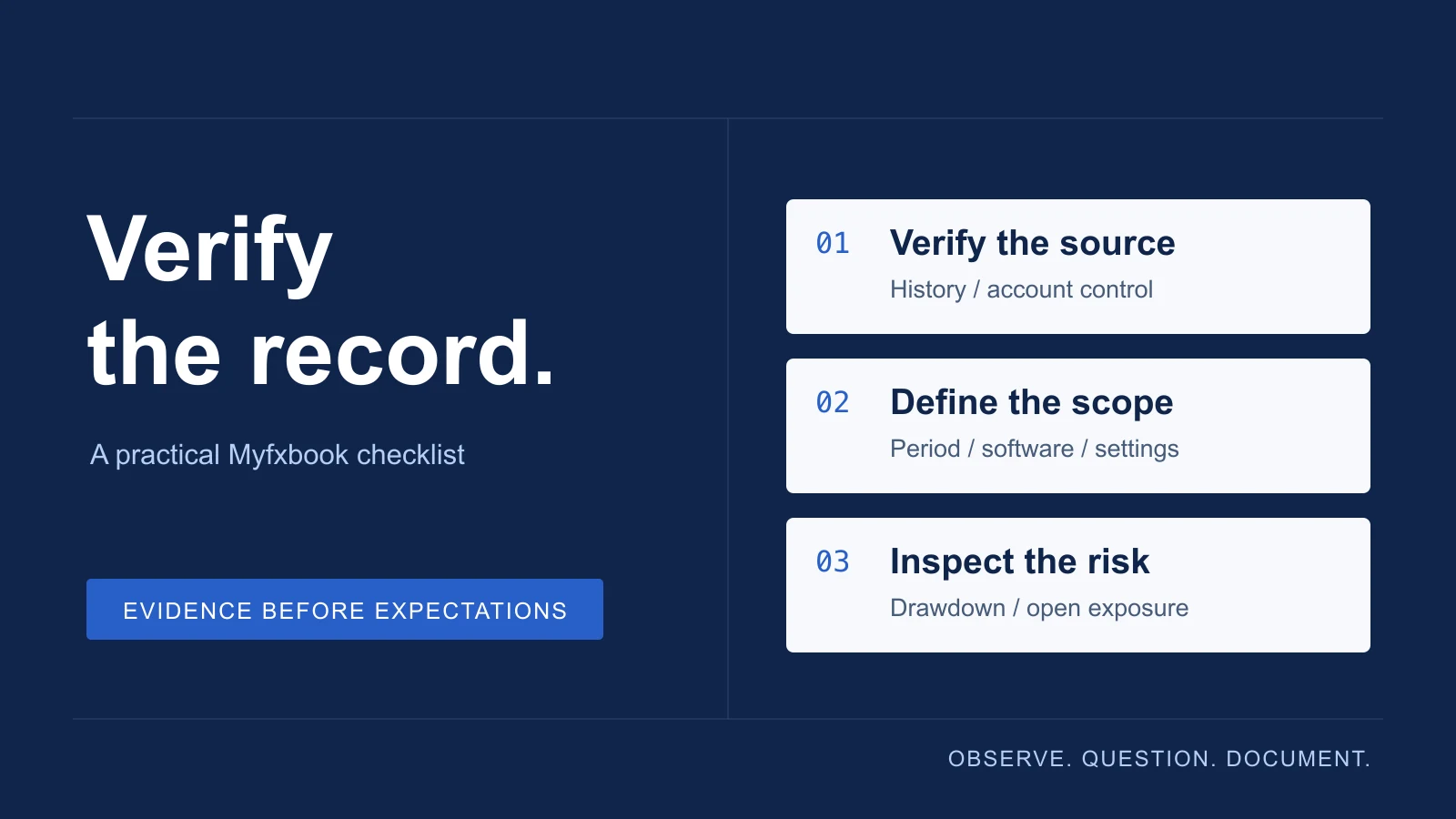
The worksheet above records questions and evidence; it does not certify compliance. For an unfamiliar EA, start with our trading-results verification checklist, then test the exact configuration against the chosen rules.
What has to happen before FTMO pays a reward?
An eligible simulated profit must meet the objectives and Account Agreement. FTMO states that a reward can be requested from day 14 after the first trade on the specific account, with positions and pending orders closed. A request is then reviewed; day 14 is not a guaranteed payment date. Reward process.
A payout screenshot can support one person's experience if authentic. It cannot tell you the proportion of all purchasers who reach a reward, their prior attempt costs, or whether the experience will repeat. This review has no verified purchaser-cohort dataset from which to calculate your probability of success or expected net income.
Our verdict: assess the fit before paying
The documented strengths are a clearly described evaluation, published rule comparisons and a conditional route to real rewards. The trade-offs are equally concrete: upfront fees, different rules across products and phases, and no evidence here of your personal likelihood of recovering all costs.
Investigate further if you already have a documented strategy, can reproduce the loss calculations and have a budget independent of hoped-for rewards. Keep testing without paying if your main evidence is a bot seller's pass certificate, you cannot explain the daily equity rule, or another attempt would mean chasing previous fees.
A Free Trial can help you examine the environment; it cannot establish a future payout. We would prioritize understanding the rules and validating the strategy before purchasing either a Challenge or additional software.
Our role at RoboXpert is to make those checks understandable. Start with the free EA evidence guide. Any software we offer should be judged by the same evidence, risk and operating requirements—not by an implied ability to pass FTMO.
Review method and limits
We compared FTMO's current public CFD pricing, refund wording, trading objectives and EA policies, then built the cash-flow examples and calculator above. We did not buy an evaluation, verify FTMO's finances, test support or independently confirm a payout. This is an educational review of a service and its conditions, not an earnings forecast or personalized investment recommendation. Recheck the terms on the storefront available in your country before making a purchase.

Sources & further reading
- FTMO: current Global CFD pricing
- FTMO: 1-Step and 2-Step comparison
- FTMO: what the fee covers
- FTMO: entry-fee refund rules
- FTMO: simulated trading and separate live accounts
- FTMO: Trading Objectives and equity calculations
- FTMO: reward eligibility, timing and ratios
- FTMO: permitted strategies and third-party EAs
- FTMO: forbidden trading practices
- FTMO: news restrictions by account and phase
- FTMO: overnight and weekend positions
Your next question