Learn
Prop Firm EA Rules: Which Bots Are Allowed and Where Today's Loss Limit Sits
At a glance
Prop firm EA rules differ more than comparison tables suggest. FTMO allows EAs but warns about third-party EAs other traders also use; FundedNext allows them only below $50,000 and counts tools that merely set a stop-loss or lot size as EAs; FundingPips allows third-party EAs only as trade or risk managers. The daily loss limit differs as well: on the same hypothetical $100,000 account with a 5% limit, the line sits at $97,000 under FTMO's and FundedNext's rules but at $99,750 under FundingPips' when a $3,000 open profit is carried over midnight. A guard that measures 5% from midnight equity can fire after the firm's line. We read each firm's own help pages on 31 October 2026 and show how to set a daily stop that fires first.
On this page

A prop firm challenge has two sets of rules that matter to anyone who trades with an Expert Advisor. The first decides whether your EA may run at all. The second decides at which equity the day is over, and it is rarely the number a daily stop in MetaTrader assumes.
This guide covers both for three firms whose help pages state their rules clearly: FTMO, FundedNext and FundingPips. It does not rank firms or recommend one.
Disclosure and date: We read each firm's own help pages on 31 October 2026; rules change, so check the linked page before you pay. The breach levels below are our own arithmetic on a hypothetical account, not a test on a funded account. RoboXpert sells Risk Guard, a risk tool for MT5 shown below, so we have a commercial interest in this subject. AI assisted with research and drafting. See our editorial methodology.
Prop firm EA rules at FTMO, FundedNext and FundingPips
The three firms answer the same question, “may my EA run?”, in three different ways. The table sorts the answer by the kind of automation, because that is what the rules distinguish.
Scroll horizontally if needed
| Your automation | FTMO | FundedNext (CFD accounts) | FundingPips |
|---|---|---|---|
| Your own strategy EA | Allowed | Only on accounts below $50,000, on MT4 or MT5, with the paid EA add-on | Allowed for full automation “with proof of ownership” |
| A bought third-party strategy EA | Allowed, but other traders may run “exactly the same strategy”, which can cost you the funded account under its capital-allocation rule | As for your own EA; at most $300,000 allocation per EA strategy | Not allowed, except on the 1K Instant account |
| A risk or trade manager (sets stops, sizes, closes positions) | No separate rule found | Counts as an EA, so not allowed from $50,000 | Allowed: third-party EAs are permitted “strictly as a trade or risk manager” |
| A copier into your account | Not covered on the page we read | Not covered on the page we read | Not allowed (“inbound copy trading”); copying out of your own account to another of yours is allowed |
| An EA sold to pass challenges | Not covered on the page we read | Prohibited, with named examples | Covered by the general ban on third-party strategy EAs |
The sources, in the same order: FTMO's strategy FAQ also names server limits of “200 orders at a time and 2000 max positions per day” and says it may ask you to adjust an EA that causes hyperactivity. FundedNext's EA article adds that cTrader and Match-Trader accounts allow no EAs at any size and that “EAs or bots designed specifically to pass Prop firm challenges are strictly prohibited”. FundingPips' conduct standards also ban EAs in its monthly competition, account management by third parties, and strategies such as high-frequency trading, tick scalping and hedging.
Our FTMO review covers FTMO's EA rules and costs in more detail.
Is a risk manager an EA?
Here the firms contradict each other directly. FundedNext writes that “any tools that do not execute trades but instead only modify trade parameters”, such as stop-loss, take-profit or lot-size calculations, “are also classified as EAs” (FundedNext). On an account of $50,000 or more, that bans a risk manager as firmly as a trading robot. FundingPips does the opposite: a third-party EA is allowed only if it is a trade or risk manager (FundingPips).
Our own Risk Guard is such a tool. It can set a missing stop-loss, close positions at a loss limit and block new entries, so at FundedNext it counts as an EA, and on a FundedNext account of $50,000 or more you should not run it. If a seller calls a tool “not an EA” because it does not open trades, that is the seller's definition, not the firm's.
Prop firm daily drawdown: three ways to draw the line
All three firms advertise a daily limit of 3% or 5%. What the percentage is taken from differs, and so does the equity at which you breach. Each rule below is quoted from the firm's own page:
Scroll horizontally if needed
| Firm and model | The rule in the firm's words | What it means in practice |
|---|---|---|
| FTMO 2-Step (5%; 1-Step: 3%) | The limit is the account balance at 00:00 CE(S)T minus 5% of the initial capital; equity, including open positions, swaps and commissions, must not fall below it (FTMO) | A fixed amount, $5,000 on $100,000, below yesterday's closing balance |
| FundedNext Stellar 2-Step (5%) | “Daily Loss Limit = Initial Balance × Daily Loss Limit Percentage”; today's loss is “Closed Trade Results for This Day + Results from the Open Positions”, reset at 00:00 server time, GMT+2 or GMT+3 in daylight saving (FundedNext) | The same fixed amount; a profit earlier in the day widens the room, and an open position carried over midnight counts in full on the new day |
| FundingPips 2-Step Standard (3% or 5%) | The limit is 3% or 5% “of the higher value between the opening balance or opening equity for that day” (FundingPips) | A percentage of whichever was higher at the day's start, so an open profit at midnight raises the line |
The maximum loss is a separate rule: FTMO 2-Step has a static limit of 10% below the initial capital, and FTMO 1-Step raises its 10% limit with the highest midnight balance, so it only moves up. At FundingPips, “equity or balance cannot hit 10% below the starting account size”. A daily stop alone does not protect you against either.
Same account, same 5%: where the day ends
The differences only show with numbers. We took one hypothetical $100,000 account with a 5% daily limit and a balance of $102,000 at the day's start, and applied each rule to three situations at midnight: no position open, an open loss of $1,500, and an open profit of $3,000.
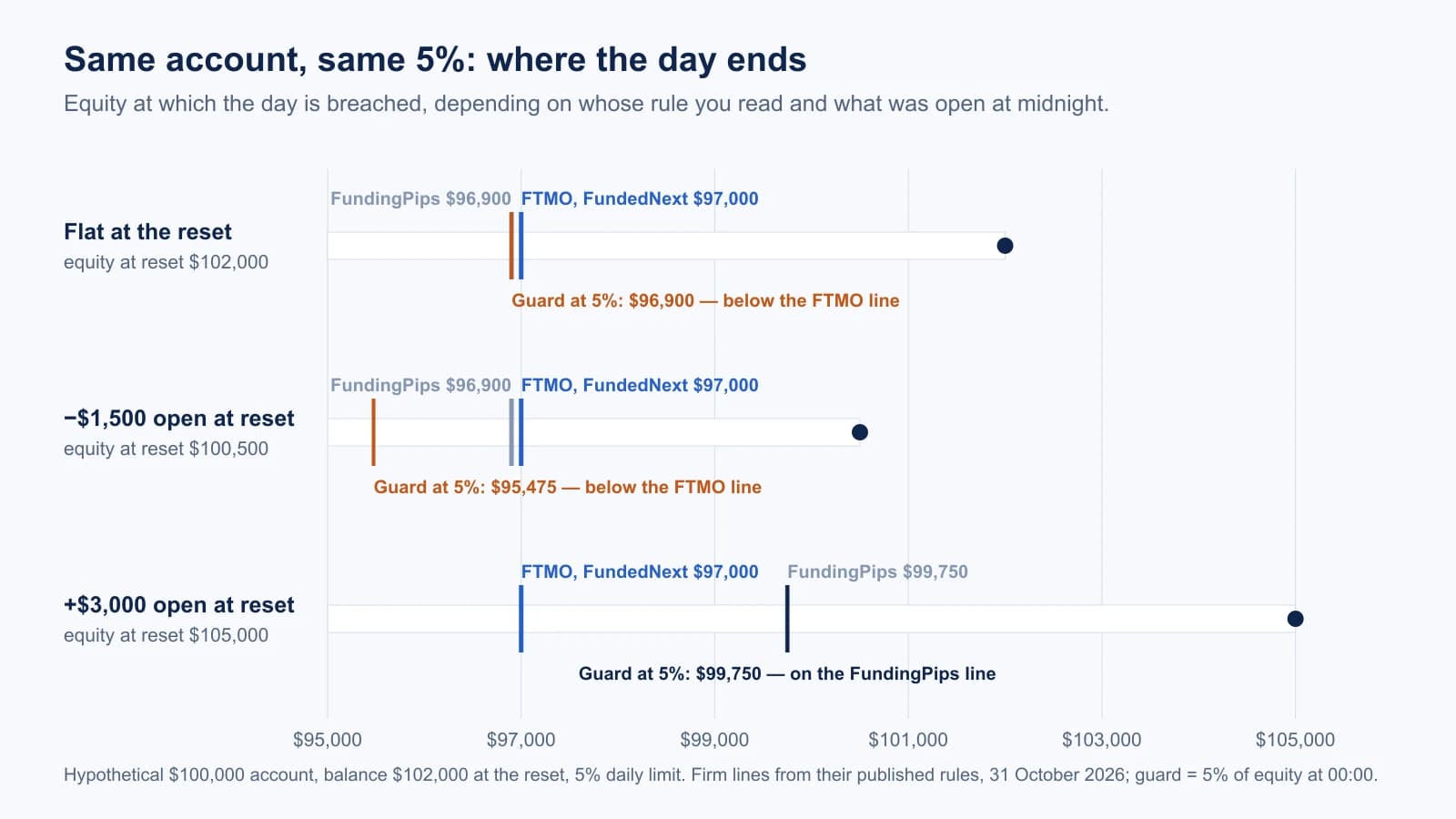
The same numbers as a table. “Guard at 5%” stands for any daily stop that counts 5% from equity at midnight, which is how Risk Guard and many similar tools measure:
Scroll horizontally if needed
| At midnight | Equity | FTMO and FundedNext line | FundingPips line | Guard at 5% of midnight equity |
|---|---|---|---|---|
| No position open | $102,000 | $97,000 | $96,900 | $96,900 |
| $1,500 open loss | $100,500 | $97,000 | $96,900 | $95,475 |
| $3,000 open profit | $105,000 | $97,000 | $99,750 | $99,750 |
Two things follow. Against FTMO and FundedNext, a guard set to the advertised 5% fires too late in the first two rows: the firm's line is a fixed $5,000 below the balance, while 5% of a grown account is more than $5,000. And against FundingPips, a carried-over profit moves the line up by $2,850, so a stop placed for yesterday's numbers no longer fits.
When does the prop firm's day start?
A daily limit needs a midnight, and the three firms do not share one. FTMO resets at 00:00 CE(S)T, the time in Germany. FundedNext resets at 00:00 server time, which it gives as GMT+2, or GMT+3 during daylight saving. That puts FundedNext's day start an hour before FTMO's for most of the year.
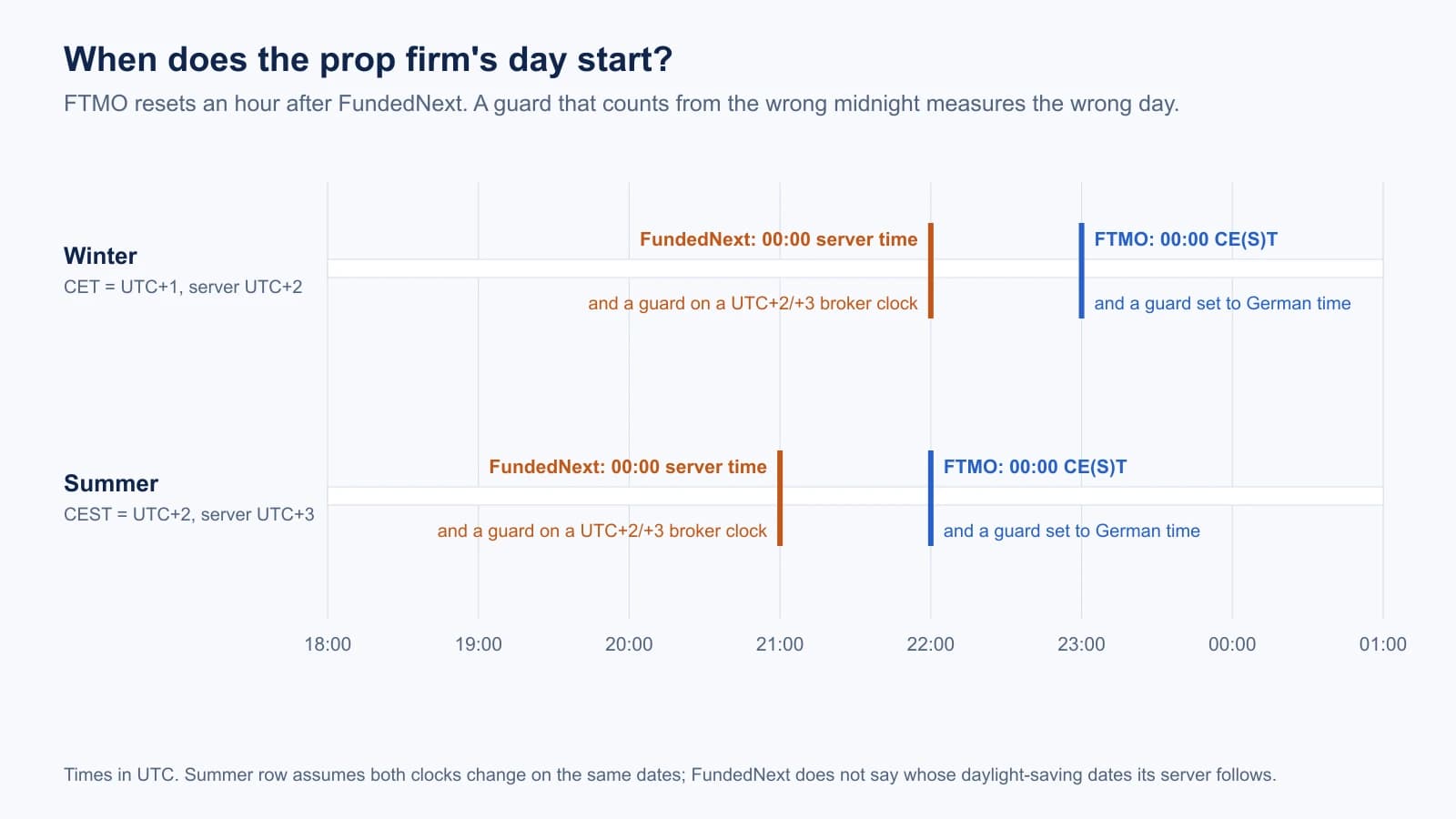
A guard that counts its day from the wrong midnight adds the hour before the firm's reset to the wrong day. FundingPips' page states the percentage and the baseline but not the reset hour; ask support before you rely on one. Why broker clocks differ in the first place, and how to read yours, is in our guide to MT5 server time.
Setting a daily stop that fires before the firm's line
A daily stop protects a challenge only if it fires above the firm's line, with room for the price to move while positions close. Three steps get you there.
- Work out today's line in money. Use the firm's rule and the values at its reset: for FTMO or FundedNext, the balance at the reset minus the fixed daily amount; for FundingPips, the higher of balance and equity at the reset minus the percentage of it.
- Turn it into the guard's percentage. If your guard measures from equity at midnight, the highest safe setting is (equity at midnight − today's line) ÷ equity at midnight, minus a buffer for slippage. In the table above that is 4.90% with no position open, 3.48% with the open loss and 7.62% with the open profit, before any buffer.
- Recompute whenever something stays open over the reset, or close positions before it. With no position open at midnight, equity equals balance and the percentage only moves as the account grows.
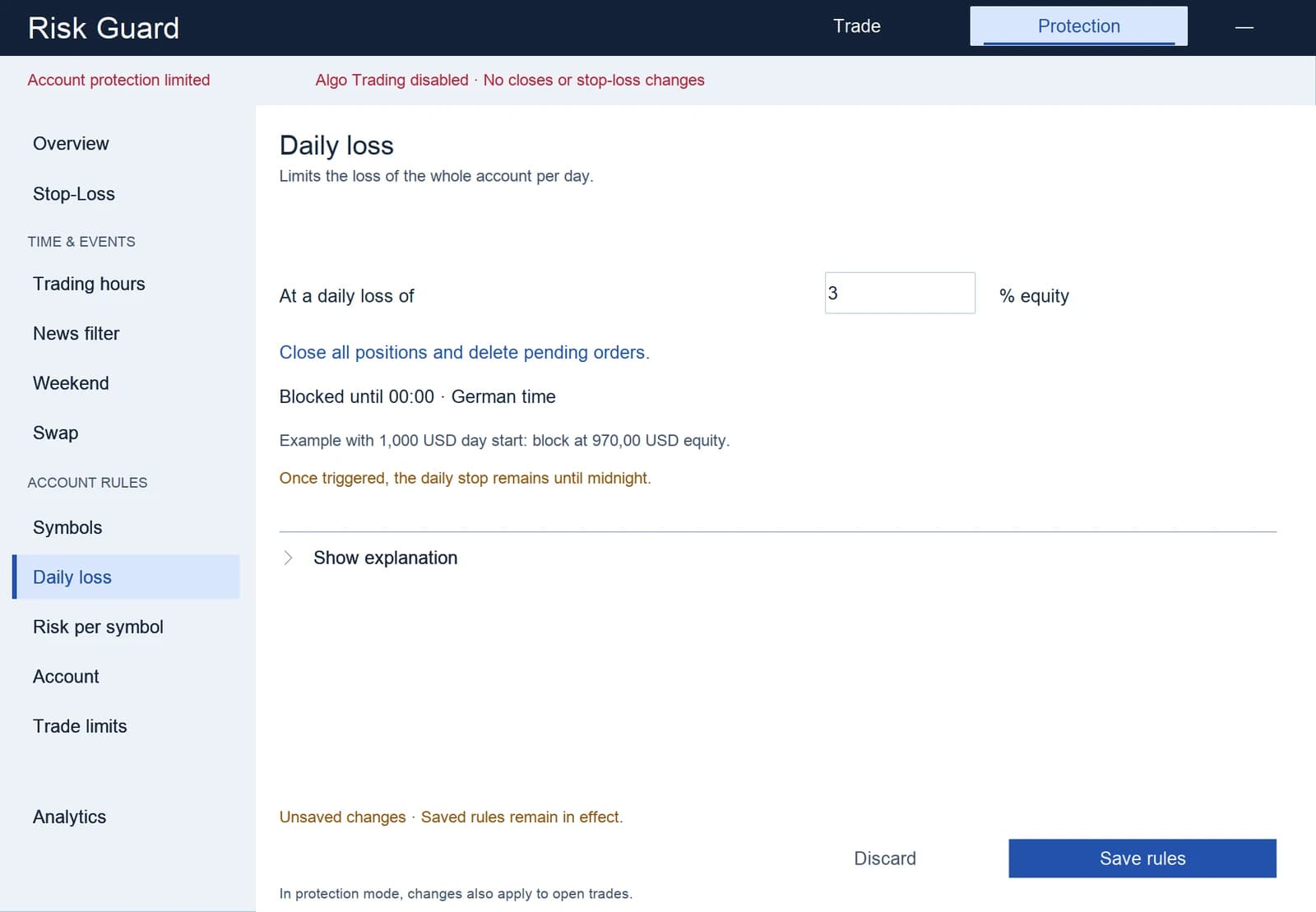
In Risk Guard, the daily stop is a percentage of equity at the day's start; the screenshot shows 3%, with the day counted in German time. That clock matches FTMO's reset; for a FundedNext account, choose “Broker time” instead and set the broker clock to UTC+2 with daylight saving, matching the GMT+2/+3 server time FundedNext names. Risk Guard has no overall maximum-loss rule, and like every MT5 tool it only acts while MetaTrader is running and connected, which in practice means a VPS.
Questions to ask the firm before you buy a challenge
Rules on help pages are written for the common case. If your setup is not common, get the answer in writing before you pay.
- Which account sizes and platforms allow EAs, and does that include tools that only set stops or close positions?
- For a bought EA: is it allowed, and do you need proof of ownership? Name the EA and its version.
- How many orders and modifications per day does your EA send? FTMO names server limits; your EA's log or a Strategy Tester run gives the count.
- Which clock and which reference value does the daily limit use, and is an open position carried over midnight counted in full?
- Is a trade copier allowed, in which direction, and between whose accounts?
What we did not check
- We did not buy a challenge or run an EA or Risk Guard on a funded account; the breach levels are arithmetic from the published rules.
- We covered three firms. The5ers' programme page lists a 5% daily and 10% maximum loss but, when we read it, did not say from which value they are measured or what it says about EAs, so we left it out.
- FundingPips' 2-Step Standard page does not give the reset hour. Other FundingPips models may differ.
- Firms change these rules often. Every statement here carries the date we read it.
Frequently asked questions
Which prop firms allow EAs? Of the three we read, FTMO allows EAs on its standard models, FundedNext only on accounts below $50,000 with a paid add-on, and FundingPips allows your own EA with proof of ownership but third-party EAs only as trade or risk managers.
Does a risk manager EA count as an EA at a prop firm? At FundedNext, yes: tools that only change stop-loss, take-profit or lot size are classified as EAs. At FundingPips, a third-party risk manager is exactly the kind of EA that is allowed.
How is the daily drawdown calculated at a prop firm? It depends on the firm. FTMO and FundedNext subtract a fixed share of the initial balance from the day's starting balance; FundingPips takes a percentage of the higher of opening balance and opening equity. All three count open positions.
Is a 5% daily stop in MT5 enough for a 5% prop firm limit? Not if the stop counts 5% of current equity and the firm counts 5% of the initial balance. On a grown account the stop then fires below the firm's line. Set it from today's line in money instead.

Sources & further reading
- FTMO: Trading objectives (Maximum Daily Loss, Maximum Loss)
- FTMO FAQ: Which instruments can I trade and what strategies am I allowed to use?
- FundedNext Help Center: Does FundedNext allow EAs and indicators? (updated 8 September 2026)
- FundedNext Help Center: How can I calculate the daily loss limit? (updated 8 April 2026)
- FundingPips Help Center: Trading Conduct and Security Standards
- FundingPips Help Center: 2 Step Standard, account violations
Your next question