Learn
Is AI Trading Legit? Check a Trading Bot Before You Pay or Deposit
At a glance
Is AI trading legit? AI trading software is legal and exists, but whether one offer is legitimate depends first on who holds your money: your own broker, a manager with access to your account, or the provider itself. In three cases the SEC filed in 2026, investors sent about $27.6 million to the provider; according to the complaints, no AI bot traded, the profits on screen were invented and withdrawals were blocked. This guide sorts an offer by where the money sits, lists the warning signs from those cases, shows what the promised returns would mean and explains how to check a registration yourself.
On this page

“Is this AI trading bot legit?” has two questions inside it. Is the offer real, or a way to take your money? And if it is real, does it make money? This guide answers the first one. The second comes later, and other guides on this site deal with it.
The first question can usually be settled without understanding any AI. You need to know where your money goes, who can place orders with it and who decides whether you get it back.
Research cutoff and disclosure: We read the three SEC complaints of 2026 and the regulator pages listed below on 31 October 2026. Everything said about the defendants is an allegation by the SEC, not a court finding; we found no response from them in the sources we read. RoboXpert sells Expert Advisors that run in the buyer's own MetaTrader account, so we have a commercial interest in this subject. This page links to none of our products and contains no affiliate links. Our licences are tied to an account number and never ask for a password; apply the checks below to us too. AI assisted with research and drafting. See our editorial methodology.
Is AI trading legit?
AI trading as such is legal and exists. Software that uses statistics or machine learning to place orders runs at banks, funds and on private accounts. What the CFTC warns about is the promise attached to it: its advisory says plainly that “AI technology can’t predict the future or sudden market changes” (CFTC).
Whether one particular offer is legitimate depends far less on the AI than on where the money sits. In the three “AI trading bot” cases the SEC filed in 2026, investors sent about $27.6 million to the provider. According to the complaints, no AI bot traded, the profits on screen were invented and withdrawals were blocked. All three would have been caught by one question asked before paying: who holds my money?
Three kinds of AI trading offer: who holds your money?
Every offer sold as an AI trading bot, robot or AI platform falls into one of three setups. They differ in who holds the money, who places the orders and who can take the money out.
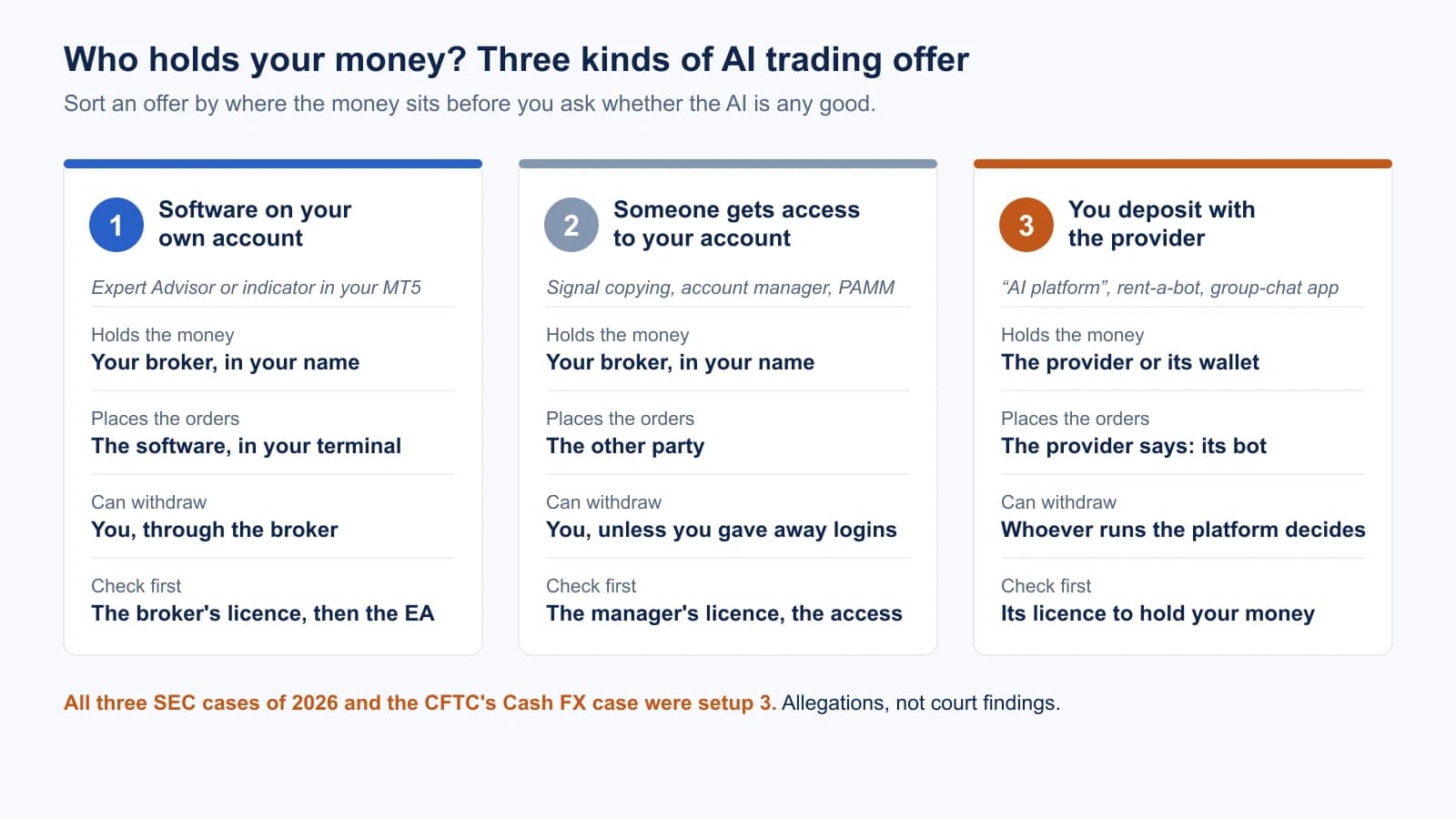
1. Software on your own account. You buy or rent an Expert Advisor, an indicator or a script and run it in your own MetaTrader or TradingView account. The money stays at a broker, in your name. The software can lose it by trading badly, but it cannot send it anywhere. What you check: the broker's licence first, then whether the software does what it claims.
2. Someone gets access to your account. A signal service copies trades into your account, an “account manager” trades it for you, or your money goes into a manager's pool at the broker (PAMM). The money still sits at your broker, but someone else decides what happens to it. In MetaTrader the difference lies in the password you hand over: according to the MetaTrader 5 help, investor access lets someone “see the account status, analyze prices, and work with your own Expert Advisors, but not trade”. The master password trades. What you check: whether the manager is licensed to manage money where you live, and exactly what access you give.
3. You deposit with the provider. You send money or crypto to an “AI platform”, rent a bot on the provider's website or join an app recommended in a group chat. Now the provider holds the money, shows you a balance in its own app and decides whether you get it back. You cannot see a single trade at a broker. What you check: whether the firm is licensed to hold client money at all.
Setup 3 is not automatically fraud; a regulated fund or a crypto exchange also holds your money. But it is the setup in which a fake bot costs nothing to run, because nobody outside the provider can see whether it trades.
What the SEC's 2026 AI trading bot cases show
The SEC filed three civil complaints in 2026 against offers sold as AI trading bots. The figures below come from the complaints; paragraph numbers are given so you can check them.
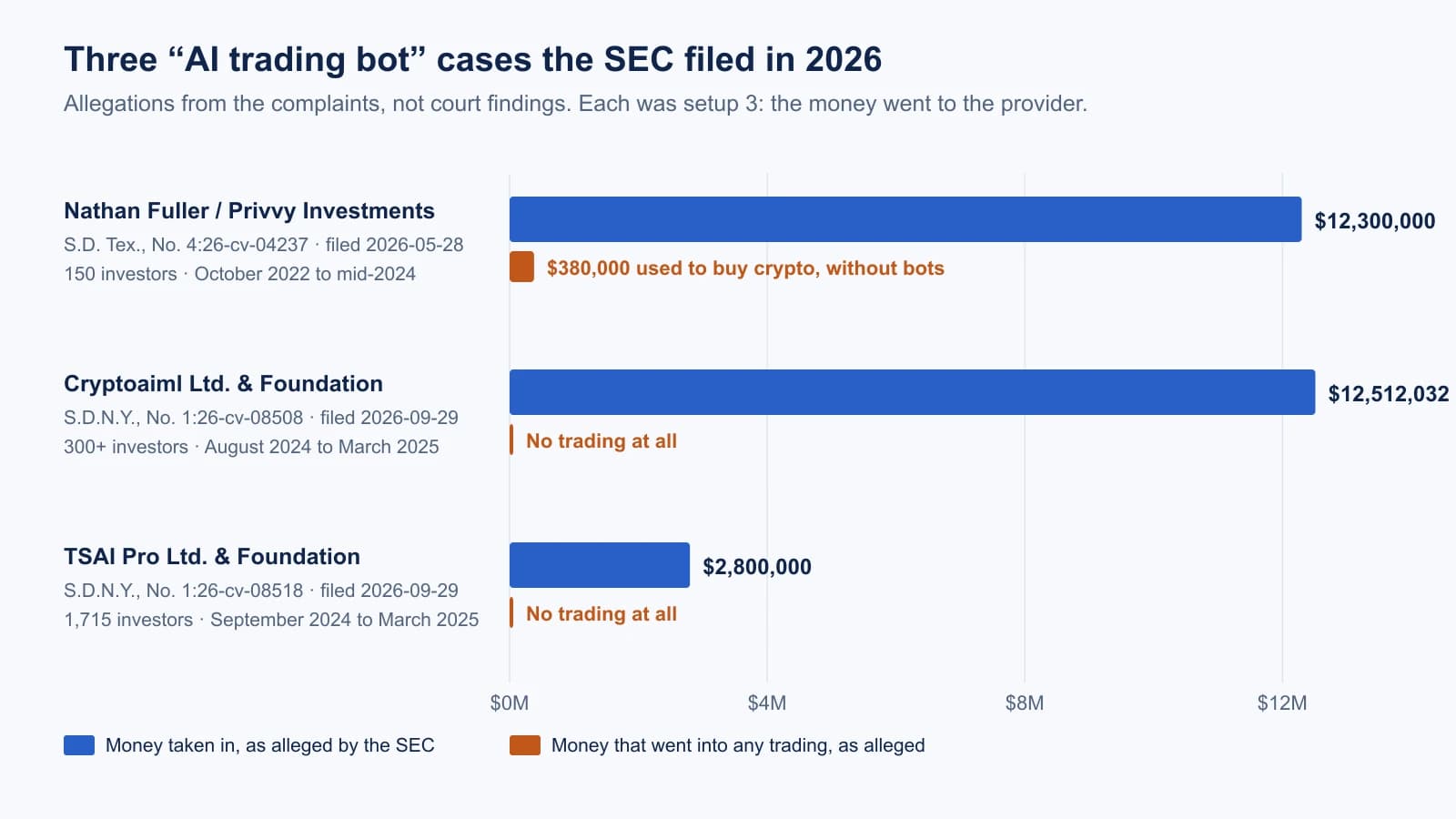
The table sets what each offer said against what the SEC alleges happened:
Scroll horizontally if needed
| Case | What investors were told | What the SEC alleges |
|---|---|---|
| Nathan Fuller / Privvy Investments, S.D. Tex. 4:26-cv-04237, filed 28 May 2026 | AI-based bots doing high-frequency arbitrage between crypto exchanges, a stop-loss limiting losses to 3%, returns of “over 40-50% within 30 to 45 days” (para. 19, 21) | The bots “did not function as represented”; their code contained no stop-loss or AI. Only about $380,000, roughly 3% of the $12.3 million raised, bought crypto, without bots. About $6.2 million went on personal spending and $5.5 million on Ponzi-like payments (para. 3, 23, 28) |
| Cryptoaiml Ltd. and Cryptoaiml Capital Foundation, S.D.N.Y. 1:26-cv-08508, filed 29 September 2026 | WhatsApp groups run by advisers presented as working for Raymond James and Citadel Securities; AI signals with “a 98% accuracy rate”; a platform “certified by the SEC as well as the MSB” (para. 36–47) | The advisers were impersonated; “no trading took place”; profits on the platform were fictitious. At least $12.5 million from more than 300 investors (para. 35, 91–92) |
| TSAI Pro Ltd. and TSAI Capital Foundation, S.D.N.Y. 1:26-cv-08518, filed 29 September 2026 | Rent an AI trading bot: $100 for two days paying $10 a day, up to $500,000 paying $17,500 a day for 360 days; commissions for recruiting; an “SEC certificate” on the website (para. 17, 23–27) | “There were no AI trading bots”; the certificate was fake. At least $2.8 million from about 1,715 investors (para. 3–4, 43, 49) |
In all three, the money went to the provider: Fuller signed joint-venture agreements and took the deposits (complaint, para. 15); Cryptoaiml and TSAI gave each investor a crypto wallet address they controlled (Cryptoaiml, para. 93; TSAI, para. 26). The SEC's press release adds that the Cryptoaiml and TSAI entities were likely run from overseas; no individual was charged in those two cases.
The CFTC's case against Cash FX Group, filed on 24 September 2026, follows the same pattern with forex instead of crypto. Our Cash FX explainer covers it.
Seven warning signs of a trading bot scam
Each of these signs appears in at least two of the three complaints. None proves fraud on its own; together they describe the cases above almost completely.
Scroll horizontally if needed
| Warning sign | Fuller | Cryptoaiml | TSAI |
|---|---|---|---|
| Fixed or guaranteed returns. A real strategy has losing months. | “guaranteed profits exceeding 100%” (para. 2) | “Citadel Securities” to “bear up to 90% of your trading risks” (para. 53) | fixed daily payouts per bot (para. 23–24) |
| You deposit with the provider, not at a broker in your name. | yes (para. 15) | yes (para. 93) | yes (para. 26) |
| A licence, insurance or certificate you cannot find in a register. | money-transmitter licence, FDIC, surety bond (para. 24) | “SEC and MSB double certification” (para. 48) | SEC certificate (para. 17) |
| Borrowed or invented names. | invented insurer and audit firm (para. 25, 27) | impersonated real advisers (para. 37–45) | Form D director not linked to the firm (para. 46) |
| Commissions for bringing in others. | referral payments (para. 13) | — | recruiting commissions (para. 27) |
| Profits shown only in the provider's own app. | web app with false balances (para. 26) | platform showing profits (para. 3) | dashboard with fake returns (para. 28, 44) |
| Withdrawals blocked, or fees and “taxes” to unlock them. | fake audit letter, “KYC verification” (para. 27) | accounts “frozen”, fees wired to “market makers” (para. 79–86) | “suspicion of illegal arbitrage”, “taxes” (para. 67–70) |
The last sign deserves a separate word. In the Cryptoaiml case, the SEC says some investors sold securities from their stock portfolios or 401(k) accounts to pay the unlock fees (para. 88). A request for money before you can withdraw money is the clearest signal in the whole list.
What the promised returns would mean
The promises in these complaints sound modest one at a time. Repeated for a year, they become impossible. The chart applies each rate to a single $1,000 stake.
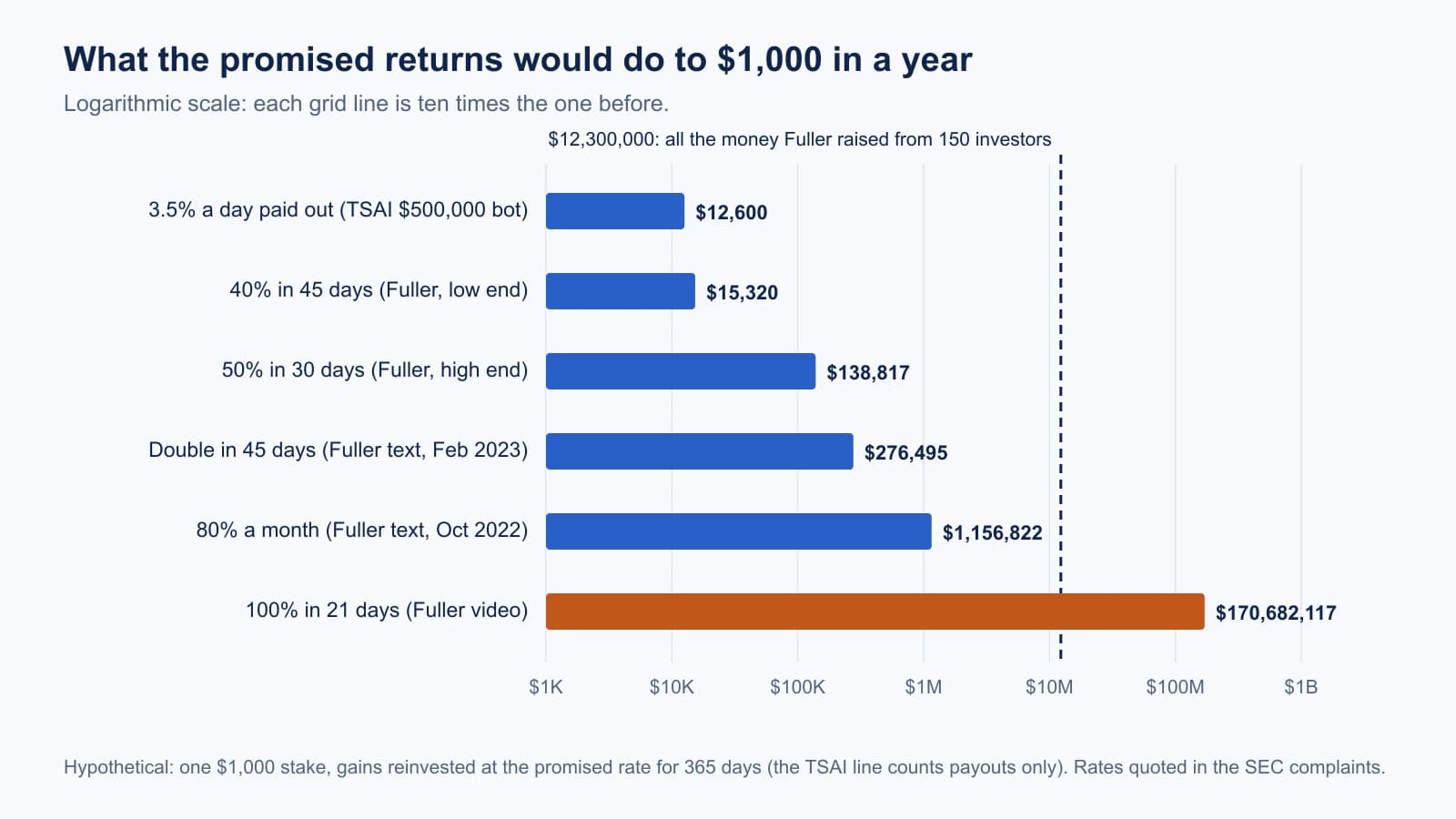
The figures behind the chart, all hypothetical:
Scroll horizontally if needed
| Promise (source) | $1,000 after one year |
|---|---|
| 3.5% a day, paid out for 360 days (TSAI $500,000 bot, para. 24) | $12,600 in payouts |
| 40% in 45 days (Fuller, low end, para. 21) | $15,320 |
| 50% in 30 days (Fuller, high end, para. 21) | $138,817 |
| Double in 45 days (Fuller text message, para. 21) | $276,495 |
| 80% a month (Fuller text message, para. 21) | $1,156,822 |
| 100% in 21 days (Fuller video, para. 22) | $170,682,117 |
One investor's $1,000 at the last rate would end the year with more than all 150 investors together paid Fuller. The Cryptoaiml management agreement went furthest: it waived the adviser's fee as long as profits reached 1,200% a month (complaint, para. 74). For a sense of scale on monthly claims, our article on 100% a month with an indicator works through the same arithmetic.
How to check whether an AI trading platform is registered
A registration check takes ten minutes and would have exposed every claim in the table above. Three rules come first.
- Search the register yourself. Do not follow a link, certificate or screenshot from the provider. The Cryptoaiml website had an “SEC” tab that displayed real results from sec.gov for its own Form D (complaint, para. 26).
- A filing is not a licence. A Form D is “a notice of an exempt offering of securities” (SEC). Investor.gov states that a Form D “has nothing to do with whether an individual or firm is registered or licensed”, and that “the SEC does not issue registration certificates” (Investor.gov). According to the SEC, the Cryptoaiml and TSAI Form D filings have since been removed from its website.
- An MSB registration is not approval either. Cryptoaiml and TSAI both pointed to a registration as a money services business with FinCEN. FinCEN's own search page says: “FinCEN does not approve or endorse any business that has registered as an MSB” (FinCEN).
Which register you need depends on the country where the firm says it is regulated and on what it does:
Scroll horizontally if needed
| Firm says it is regulated in | Where to look | What should match |
|---|---|---|
| United States, securities or investment advice | The search on Investor.gov, which covers SEC advisers and FINRA brokers | Exact legal name, the person's name, the firm's address |
| United States, forex or futures | NFA BASIC; the CFTC names it for checking registration and disciplinary history | Registered category, such as a retail foreign exchange dealer, and NFA membership |
| United Kingdom | FCA Financial Services Register | Firm reference number and the websites the register lists for the firm |
| Germany | BaFin company database | Legal name and the licensed activity |
| Elsewhere, or unsure | IOSCO I-SCAN, which collects warnings from member regulators | Warnings under the firm's name or website |
If the firm only sells software you run yourself (setup 1), it may appear in no financial register at all; the register that matters then is the one for your broker. Our guide on choosing a broker for Expert Advisors shows how to match the broker's legal entity to its register entry.
Questions to ask before you pay for an AI trading bot
The questions depend on the setup. For each, the first answer decides whether the rest are worth asking.
Setup 1, software on your own account:
- Does the software need any password from you? A licence can be tied to an account number; a seller who asks for your master password is no longer selling software.
- Which broker will hold the money, and is that legal entity in its regulator's register?
- Is there a free test in the Strategy Tester or on a demo account, and what are the refund terms?
- Then the quality questions: our Expert Advisor buying checklist and the guide to verifying results on Myfxbook.
Setup 2, someone gets access to your account:
- Is the manager licensed to manage other people's money in your country? Look it up in the register above.
- Which access do you give? Investor access shows the account; the master password trades it. Broker portal logins can do more than either.
- Can you see every trade in your own account at the broker, and stop the service yourself?
Setup 3, you deposit with the provider:
- Is the firm licensed to hold client money, in a register you found yourself?
- Can you withdraw a small amount before you deposit more? A test withdrawal proves little if the provider wants your trust, but a refusal proves a lot.
- Is anyone paid for bringing you in?
If any first answer is wrong, stop there. A good-looking AI explanation does not repair a missing licence.
If you already deposited: frozen accounts and unlock fees
If an account shows profits but the provider asks for a fee, a tax or a new deposit before you can withdraw, do not pay. In all three cases the SEC describes that request as part of the scheme, not as a step towards getting money back.
- Stop sending money and keep everything: chat exports, wallet addresses, transaction IDs, bank wires, screenshots of the balance with date. The Cash FX guide has a record template.
- Report it. In the US, to the SEC through the tip portal linked in its press release, to the CFTC for forex and futures, and to the FBI's IC3. Elsewhere, to your financial regulator and the police.
- Ignore anyone offering to recover the money for a fee. The CFTC warns that “recovery scams are a form of advance-fee fraud” and that they “target victims already harmed by other frauds” (CFTC).
What we did not check
- We read the complaints, not the court dockets. Whether the defendants answered, settled or were judged is not covered here.
- We did not open accounts on or test any of the platforms.
- We counted three SEC cases from 2026 and one CFTC case. Other agencies and other countries have their own; this is not a complete list of AI trading frauds.
- We did not measure how often AI trading software in setup 1 or 2 makes money. That is a separate question, covered in Do Expert Advisors really work?
Frequently asked questions
Are AI trading bots legit? Some are real software and some are a front for taking deposits. Sort the offer first: if the bot runs on your own broker account, the money cannot leave it through the bot; if you deposit with the provider, the bot may not exist at all, as the SEC alleges in its three 2026 cases.
Is AI trading legal? Using software, including AI, to trade your own account is legal in most countries. Managing other people's money or holding client funds usually needs a licence, whether or not AI is involved.
Is a Form D or an SEC certificate proof that a platform is regulated? No. Investor.gov says a Form D has nothing to do with registration and that the SEC does not issue registration certificates.
The platform shows profits but asks for a fee before I can withdraw. What now? Do not pay. Keep your records, report the platform and ignore recovery offers. In the 2026 cases, the fees were how the schemes took more money.
Can an AI trading bot guarantee profits? No. The CFTC states that AI cannot predict the future or sudden market changes. Guaranteed returns appeared in all three of the SEC's 2026 complaints.

Sources & further reading
- SEC v. Nathan Fuller, complaint, S.D. Tex. No. 4:26-cv-04237, filed May 28, 2026 (PDF)
- SEC Litigation Release No. 26558, May 29, 2026
- SEC press release 2026-95, September 29, 2026
- SEC v. Cryptoaiml Ltd. et al., complaint, S.D.N.Y. No. 1:26-cv-08508 (PDF)
- SEC v. TSAI Pro Ltd. et al., complaint, S.D.N.Y. No. 1:26-cv-08518 (PDF)
- Investor.gov: False claims of SEC registration
- SEC: Filing a Form D notice
- FinCEN: MSB Registrant Search
- CFTC: AI won't turn trading bots into money machines
- CFTC: Check registration and backgrounds before you trade
- CFTC: Recovery frauds
- MetaTrader 5 help: authorization, master and investor access
- NFA BASIC registration search
- FCA Financial Services Register
- BaFin company database
- IOSCO I-SCAN investor alerts portal
- FBI Internet Crime Complaint Center
Your next question