Learn
Do Expert Advisors Really Work? What Results Can Prove
At a glance
Expert Advisors can automate programmed trading rules, but correct automation does not establish a profitable edge. A positive result describes a particular version, period, account and cost environment. To evaluate an EA, check execution, net economics, selection history, account-to-product attribution and operational responsibilities. Neither a backtest nor a verified live record guarantees future profit.
On this page

Expert Advisors work as automation: they can analyze conditions and perform programmed trading operations. That does not tell you whether a particular EA will make money. The useful question is whether its rules, execution and costs support a credible economic result—and whether the evidence applies to the version and setup you would use.
MetaQuotes describes EAs as programs that can perform trading operations in its platform documentation. It does not certify the profitability of every program running on the platform.
This guide gives you five separate judgments to make, an exact calculation showing why selected winners can mislead, and a worked cost reconciliation. It does not estimate the percentage of profitable EAs or review a named robot’s returns.
What does “this EA works” actually mean?
Scroll horizontally if needed
| Judgment | Evidence to inspect | What a positive finding leaves unresolved |
|---|---|---|
| Functional: it follows its specification | Signals, requests, responses, positions and exits in a documented environment | Whether those rules have an edge |
| Economic: results survive costs | Full-period gains and losses, trading costs, open exposure and external fees | Whether the result will repeat |
| Repeatable: the finding survives new observations | Rules frozen before new data, plus the history of model selection | Future market conditions |
| Attributable: the record belongs to this product | Version, settings and separation from manual or unrelated trades | Whether your execution will match |
| Operable: you can maintain it | Monitoring, restart behavior, limits and a position-management plan | Whether its risk fits your circumstances |
These are our evaluation categories, not an industry certification. A program can pass the first and fail the second. A genuine profitable account can still fail the fourth if several systems and manual trades share it.
Even the software question needs care. In MT5, a successful OrderSend() return does not by itself confirm a completed market trade. The official reference distinguishes request processing from execution and directs developers to server return codes and trade events. “The bot sent an order” therefore needs a resulting account record before becoming “the bot entered the intended position.”
Can forex robots be profitable?
An automated strategy can produce a positive result over a specified period. Whether it has a durable advantage requires more evidence than that outcome. Consider the rules, the conditions in which they trade, the costs of doing so and the uncertainty in the available sample.
There is no defensible universal profitability percentage in the sources used here. A vendor’s surviving product catalog, a set of generated backtests and all live retail EAs are different populations. A failure rate from one cannot simply be relabeled as the failure rate of another. Likewise, general CFD-account loss statistics would not isolate the contribution of EAs.
Automation can make a rule more consistent. It can also apply a bad rule consistently, or increase exposure faster than an operator expects. A fixed specification makes behavior inspectable; it does not make the specification wise.
Useful economic questions include:
- Does the result remain positive after costs at the actual trade size?
- Is the reported gain accompanied by substantial floating losses or concentrated exposure?
- Was this version chosen before the period being presented, or because it won that period?
- What did the strategy do during conditions unlike its best interval?
A lack of satisfactory answers supports “insufficient evidence.” It does not establish either “certainly profitable” or “certainly fraudulent.”
How a winner can appear without an edge
For one candidate, the chance of eight wins is (1/2)^8 = 1/256, or approximately 0.39%. For N independent candidates, the chance that at least one has eight wins is:
1 − (1 − 1/256)^N
Scroll horizontally if needed
| Candidates inspected | Chance of finding at least one eight-win record |
|---|---|
| 1 | 0.39% |
| 10 | 3.84% |
| 100 | 32.39% |
| 1,000 | 98.00% |
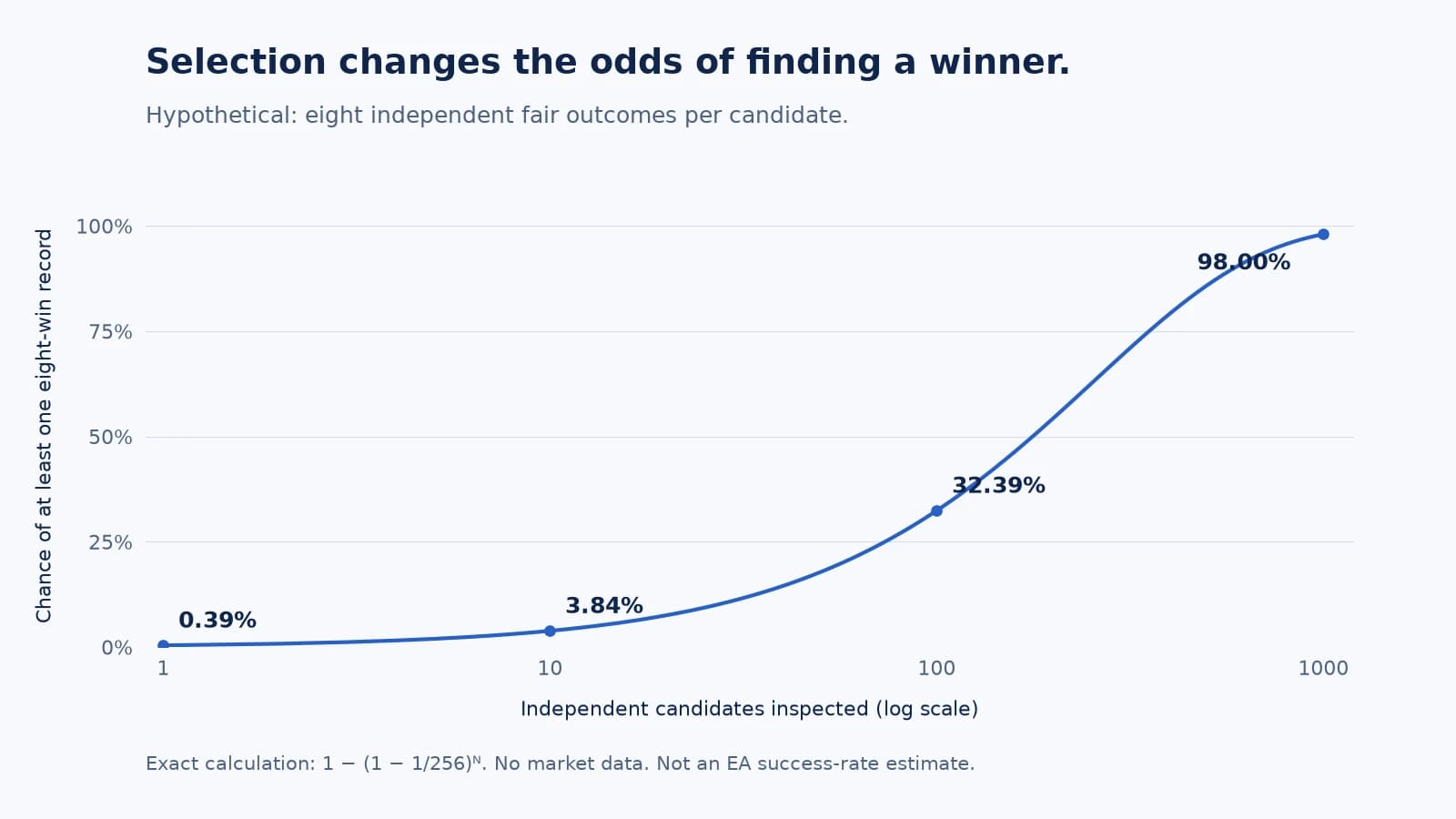
The selected record can be completely genuine: eight wins really occurred. What changes its meaning is the number of opportunities to find it. Showing only the winner hides that information.
Under this deliberately stipulated model, selecting yesterday’s winner does not improve its next independent outcome. The chance that the chosen candidate wins its next eight trials remains 1/256. We calculated these values directly; the download also exhaustively enumerates all 256 eight-outcome sequences and all 65,536 pairs to check the one- and two-candidate cases independently.
Real strategy variants often share signals and positions, so they are not independent. Real returns are not fair binary trials. Do not use the table as a numerical estimate for a vendor’s catalog or an EA’s next eight trades. The practical question it motivates is: How many alternatives, settings and date windows were considered before this result was selected?
The research paper The Probability of Backtest Overfitting, by Bailey, Borwein, López de Prado and Zhu, addresses the broader statistical problem of selecting investment strategies from repeated tests. Our elementary model illustrates selection; it does not implement the paper’s PBO statistic or its cross-validation method.
What backtests, demo accounts and live records can prove
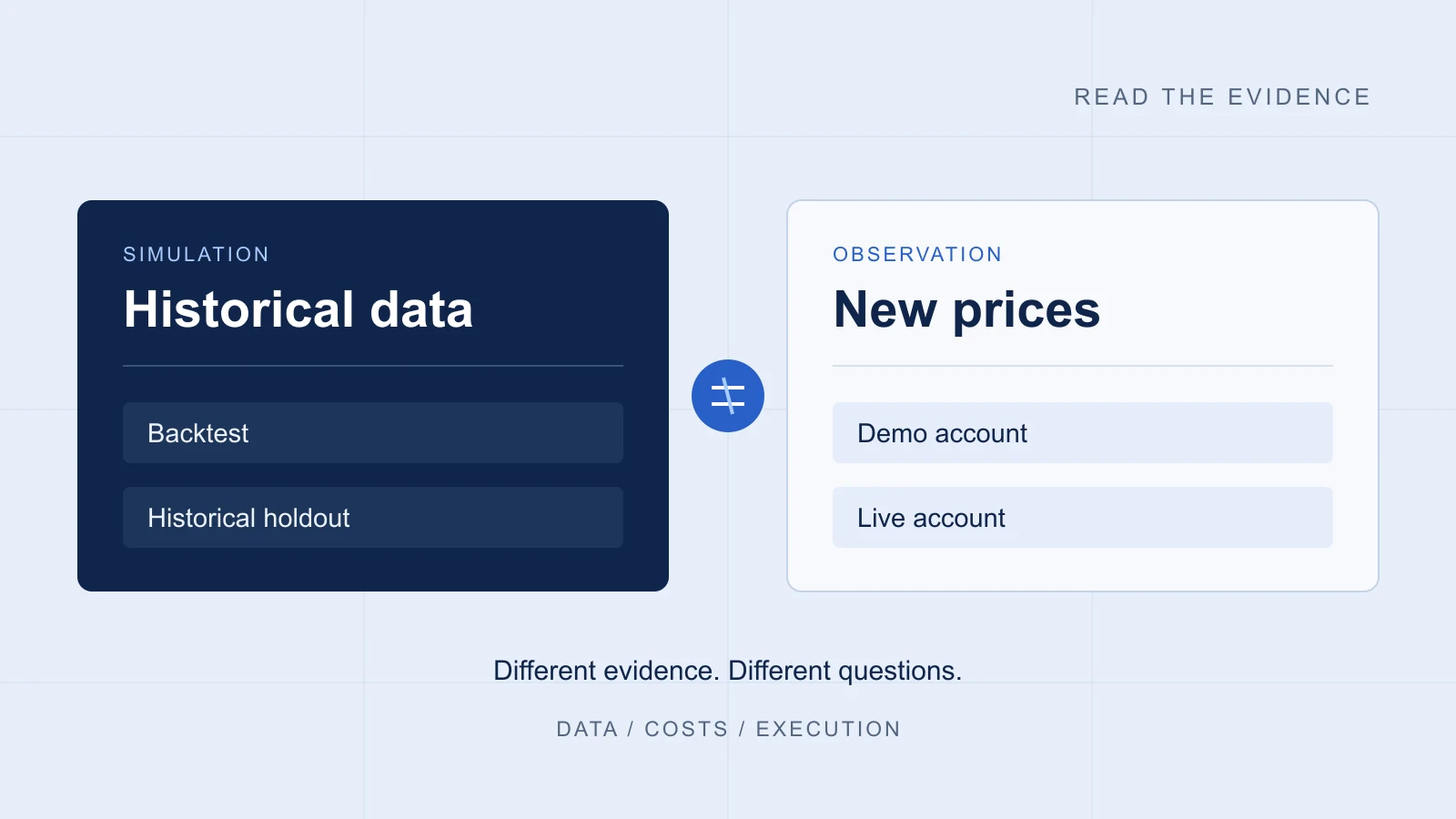
A backtest can expose incorrect logic, implausible assumptions and behavior in specified historical conditions. It remains a model. MetaTrader’s optimization documentation describes repeated historical runs with different inputs; its tester forward partition is still historical data, not a live brokerage record.
An untouched historical segment helps ask whether a chosen rule carries beyond its selection window. Once you inspect that segment and change the rule to improve it, that evidence has influenced selection too. Keep a dated record of what was frozen and what was subsequently changed.
A broker demo account adds observation over passing time and helps examine operation. A live account adds actual funded execution. Neither automatically supplies a representative sample, isolates the EA from manual intervention or predicts future conditions. See backtest vs live trading for the detailed distinctions.
For a public account, inspect what verification covers. Myfxbook separately describes track-record verification and trading-privilege verification in its verification guide. Those checks should not be expanded into a claim that an independent party certified the named EA’s code, risk limits or future profitability. Our Myfxbook evidence checklist walks through the account-to-product attribution questions.
A profitable trading result can still be an uneconomic purchase
Suppose one hypothetical month produces $300 before all listed costs, on unchanged trade sizes. The period starts and ends with no open positions and contains no deposits or withdrawals. These are invented teaching amounts, not broker prices or a tested EA result.
Scroll horizontally if needed
| Item | Hypothetical USD |
|---|---|
| Combined trading gains and losses before all costs | +300 |
| Spread cost | −100 |
| Commission | −40 |
| Adverse slippage | −30 |
| Financing | −10 |
| Trading result after these costs | +120 |
| Monthly software fee | −100 |
| Hosting for the month | −30 |
| Economic result before tax and your time | −10 |
Both “the trades made $120 after trading costs” and “the setup lost $10 after monthly operating fees” accurately describe this example. The second question matters when deciding whether paying for the software makes sense.
Do not subtract the same cost twice. In this example “before costs” is explicitly defined. A real platform’s exported profit may already incorporate spread through entry/exit prices and may account for commission or financing in particular fields. Reconcile the report before adding deductions. MetaTrader’s testing-report reference defines its own profit and drawdown fields; our table is not a replica of that report.
For an upfront software price, state the period over which you allocate it. For shared hosting, state which portion you allocate to this EA. Increasing position size is not a free solution to a fee problem: it changes exposure, possible losses and potentially execution. A favorable historical maximum drawdown is not a contractual future limit. Compare equity and balance drawdown before accepting a smooth closed-trade curve.
What makes an EA claim worth investigating?
Ask for a compact evidence packet rather than a growing collection of screenshots:
- Identity: exact executable/version, settings, intended instruments and sizing rules.
- Record: full period and evidence type, account conditions, trades and visible open exposure.
- Selection history: alternatives tried, discarded versions and dates when rules changed.
- Economics: costs included, costs omitted and fixed fees outside the account report.
- Operations: who monitors failures, how exposure is reconciled, and what happens on restart.
A seller may legitimately protect source code. That does not make every aspect of behavior unknowable. At minimum, you need understandable exposure, exit and failure-handling rules to evaluate what you are delegating.
Be particularly careful when a claim substitutes “AI” for these records. The CFTC’s 25 January 2024 customer advisory warns about exaggerated or guaranteed returns marketed through AI and trading bots, and highlights the effect of fees and subscription costs. That warning is relevant to evaluating claims; it is not a finding that every automated system is a scam.
A program written with AI assistance is also different from one using a model in its trading decisions. Neither description supplies the missing evidence. Our AI-assisted MT5 development example deliberately documents a signal logger rather than claiming to have created a profitable EA.
Decide what to do next
If the rules or record are too opaque, record the missing facts and stop short of a profitability conclusion. If the evidence is inspectable but execution is untested in your environment, a controlled demo evaluation can answer operational questions. Write down the expected behavior and review triggers before seeing the outcome.
Examples of review triggers include an unexpected position size, unexplained duplicate orders, loss of monitoring or a mismatch between the documented exit and the observed action. Agree how existing exposure will be managed when a trigger occurs. Simply removing an EA can also remove the automation that was managing its positions.
The EA selection checklist covers purchase and compatibility questions. If installation is the immediate task, follow the MT5 Windows installation guide.
Reader resource · ZIP
Reproduce the evidence examples
Python arithmetic with exhaustive checks, assumptions, and a blank EA evidence decision record. No market data or trading connection.
Download the evidence labFrequently asked questions
Do free Expert Advisors work as well as paid ones?
Price does not establish an edge. Apply the same evidence requirements to both. A free robot can have trading costs, exposure and maintenance demands; an expensive one still needs a credible, attributable record.
Are EAs better than manual trading?
That requires a defined comparison: the same rules, available information, costs, exposure and period. Automation can implement a schedule consistently, but that operational advantage does not prove superior investment results. Human intervention can also change what is actually being tested.
How long should I test an EA?
There is no universal number of weeks or trades that proves profitability. A frequent strategy can generate many highly related observations; a slow strategy may encounter few entry conditions in a month. Separate the time needed to inspect behavior from the evidence needed to assess economic uncertainty. State what your sample has—and has not—covered.
Can an EA make passive income?
A robot can automate tasks, but its owner still has decisions about exposure, software changes, failures, costs and monitoring. Treat an unattended-income promise as a claim needing evidence, not as a property of automation.
Scope and commercial disclosure
Sources were checked on 27 September 2026. The probability and cost examples are original, reproducible teaching calculations. We did not run a population study of commercial robots or verify a named EA’s investment performance for this article. RoboXpert develops trading software and therefore has a commercial interest in this subject. None of the examples establishes the profitability of our own products.

Sources & further reading
- MetaQuotes: Expert Advisors and custom indicators
- MQL5 Reference: OrderSend and execution confirmation
- Bailey, Borwein, López de Prado and Zhu: The Probability of Backtest Overfitting
- MetaTrader 5: strategy optimization and historical forward testing
- MetaTrader 5: testing report definitions
- Myfxbook: verification
- CFTC: AI trading-bot customer advisory, 25 January 2024
Your next question